Content Strategy for SMBs: How Topic Clusters Drive More Traffic
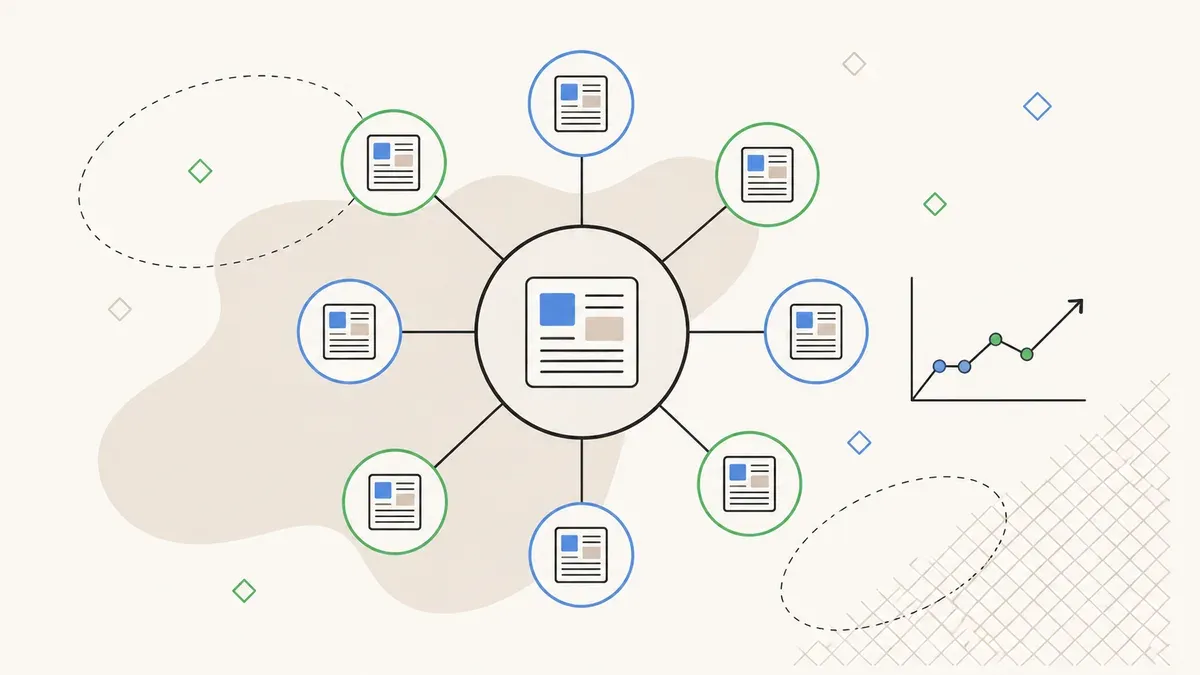
+34% more organic traffic, 2.5x longer rankings, 3.2x more AI citations. Why standalone blog posts fail to rank and how the cluster approach turns content into the most affordable lead channel.
Four blog posts a month, each on a different topic, none linking to the others. That is the content strategy of most SMBs. And it is the reason those articles stop generating traffic after three months. Google does not understand what the website is about, visitors find no logical path to go deeper, and the investment in content evaporates.
The cluster approach works differently. A central pillar page covers a core topic, 8 to 12 spoke articles explore subtopics and link back. Google recognizes topical authority, ranks the entire group higher, and your content becomes a self-reinforcing system. For SMBs with limited budgets, this is the difference between content as a cost center and content as the most affordable lead channel. The foundation for all of this is a solid SEO strategy.
Clusters beat standalone posts.
On every metric.
traffic growth
ranking stability
in AI answers
Why standalone blog posts do not work
Most SMB blogs produce what SEOs call "scattered content": topically unrelated articles that are not embedded in any overarching structure. A trades business writes about grants, then about material selection, then about seasonal offers. None of the articles reference each other, none build on each other.
The problem is not the quality of individual pieces. The problem is the missing architecture. Google increasingly evaluates websites based on whether they cover a topic comprehensively and coherently. Since the Helpful Content Update in December 2025, sites with cluster architecture have gained 23% more organic visibility. Scattered content loses ground, even when individual articles are well written.
The economic argument is equally clear: content marketing returns $7.65 per dollar spent on average and is 62% cheaper than outbound marketing while generating 3x more leads. But this ROI only materializes when content pieces work together. Standalone articles decay. Clusters accumulate.
What a topic cluster is and how to build one
A topic cluster consists of three elements: a pillar page, multiple spoke articles, and systematic internal linking.
The pillar page is your comprehensive overview of a core topic. It covers the subject broadly but does not go too deep on any subtopic. Instead, it links to spoke articles that explore individual aspects in detail. On zenku.studio, our service pages like SEO for SMBs serve as pillar pages.
Spoke articles are blog posts that cover a subtopic of the pillar page. They link back to the pillar page and to each other. Start with 8 to 12 spokes and grow to 20 to 30 over time. At a publishing frequency of 4 articles per month, your first cluster stands after roughly 3 months.
Internal linking ties everything together. 2 to 5 contextual links per 1,000 words is the optimal range. The pillar page links to all spokes, each spoke links back to the pillar page and to 2 to 3 related spokes. Internal linking alone can boost rankings by up to 40% and improve crawl efficiency by 40 to 70%. Pages more than 4 clicks from the homepage are crawled 70% less frequently. The technical foundations for a clean crawl architecture are covered in our Technical SEO Audit Checklist.
Clusters vs. scattered content: the numbers
The performance gap between cluster architecture and scattered standalone articles is measurable and substantial.
| Metric | Standalone articles | Topic cluster |
|---|---|---|
| Organic traffic growth | Baseline | +34% more |
| Ranking stability | 3 - 6 months | 2.5x longer |
| AI citations (ChatGPT, Perplexity) | Baseline | 3.2x more frequent |
| Keyword rankings (focused vs. broad) | Baseline | +55% better |
| Google HCU Dec. 2025 | Visibility loss | +23% visibility |
| Long-tail conversion rate | 2.35% (short-tail) | up to 36% (long-tail) |
Focused clusters that cover a tightly defined topic outperform broad clusters by 55% in keyword rankings. Less is more, as long as coverage within the topic is comprehensive.
The effect compounds over time. HubSpot documented a Domain Authority increase from 49 to 60 after switching to cluster architecture, along with a 500%+ increase in clicks to the affected pages.
Long-tail keywords: where SMBs gain leverage
Head terms like "content marketing" or "SEO" are dominated by enterprise websites. For an SMB publishing 4 articles per month, these keywords are out of reach. Long-tail keywords, on the other hand, are the natural habitat of spoke articles.
Over 70% of all search queries are long-tail. They consist of 3 to 5 words, carry lower search volume per keyword, but collectively account for the majority of traffic. And they convert better: the conversion rate for long-tail keywords reaches up to 36%, compared to 2.35% for short-tail terms. Pages optimized for long-tail keywords rank 11 positions higher on average than their competition.
An example: instead of targeting the generic term "tradesperson website," our article on Local SEO for Tradespeople targets more specific queries like "plumber Google Maps ranking tips" or "local SEO trades business 2026." Less competition, higher relevance, better conversion.
In a cluster context, this means: your pillar page targets the competitive head term. Your spoke articles each capture a long-tail keyword and pass topical authority back to the pillar page. Over time, you start ranking for the bigger terms too, without competing head-on against corporations.
Content clusters and AI search: double dividend
Google is no longer the only place where your content gets discovered. ChatGPT, Perplexity, Gemini, and Google AI Overviews answer search queries directly and cite sources in the process. Clustered content is cited 3.2x more often as a source in AI answers than standalone articles. The reason: AI systems evaluate topical depth and internal consistency.
When you cover a topic with a pillar page and 10 spoke articles, an LLM recognizes your website as an authoritative source on that topic. A single blog post floating in isolation lacks those signals. How to optimize your content for AI citations is covered in our article on GAIO and AI search optimization.
The Google Helpful Content Update from December 2025 amplifies this effect further. Sites with cluster architecture gained 23% organic visibility, while isolated content was demoted. Google and AI systems reward the same trait: coherent, deep coverage of a topic.
Your first cluster in 90 days: the roadmap
You do not need to publish 30 articles at once. A functioning cluster can be built at 4 articles per month over 3 months.
Month 1: Choose your topic. Define the pillar page and research 8 to 12 spoke topics. Write and publish the pillar page plus 3 to 4 spoke articles. Set up internal linking from the start.
Month 2: Publish 4 more spoke articles. Update the pillar page with links to the new spokes. Start promoting through email automation and social media to generate initial signals.
Month 3: Close the cluster with the final 2 to 4 spokes. Optimize the landing pages in your cluster for conversion. Analyze early ranking data and adjust titles, meta descriptions, and internal links.
From month 4 onward, you can start the next cluster while the first gains authority. SEO investments reach break-even after 12 to 18 months. After that, content becomes the most cost-efficient lead channel you have, with an average ROI of $22 per dollar invested.
80% of B2B purchase decisions happen without direct sales contact. Your content fills that role. But only if it is structured, discoverable, and topically authoritative.
What zenku.studio does differently
We practice what we recommend. The zenku.studio website runs on 9 topical clusters and over 30 blog articles. Every service page functions as a pillar page, every blog post is a spoke in a defined cluster. This is not a theoretical concept; it is the architecture you are reading right now.
Our SEO cluster connects the pillar page SEO for SMBs with spoke articles like Technical SEO Audit Checklist, Local SEO for Tradespeople, GAIO and AI Search Optimization, and this article you are reading now. Each article links contextually to related content, not as a link list at the bottom, but woven into the reading flow.
For our clients, we implement content strategy using the same principle: topic research, cluster planning, keyword mapping at the spoke level, pillar page architecture, and systematic internal linking. The result is not a blog that generates traffic. It is a system that generates leads.
Content strategy that turns traffic into customers?
We analyze your topic space, plan your cluster architecture, and build the first pillar pages. From keyword research to internal linking.
Free initial consultation →