Email Automation for SMBs: 3 Flows That Drive Revenue Immediately
2% of emails generate 37% of revenue. Three automated flows – welcome series, follow-up, re-engagement – that you set up once and that keep driving revenue on autopilot.
37% of all email revenue comes from automated sequences. Those sequences account for roughly 2% of total email sends. A tiny fraction of your emails doing more than a third of the heavy lifting. For small and mid-sized businesses without a dedicated marketing team, this is the highest-leverage channel available right now.
Most SMBs still send batch newsletters. One email, same content, entire list. That approach leaves money on the table every single week. The three flows in this guide take a few hours to set up and run on autopilot from day one. No coding required, no enterprise budget needed.
Email does $36–42 per dollar.
Most of it from 2% of sends.
on email marketing
comes from automations
are automated
What Email Automation Means for SMBs
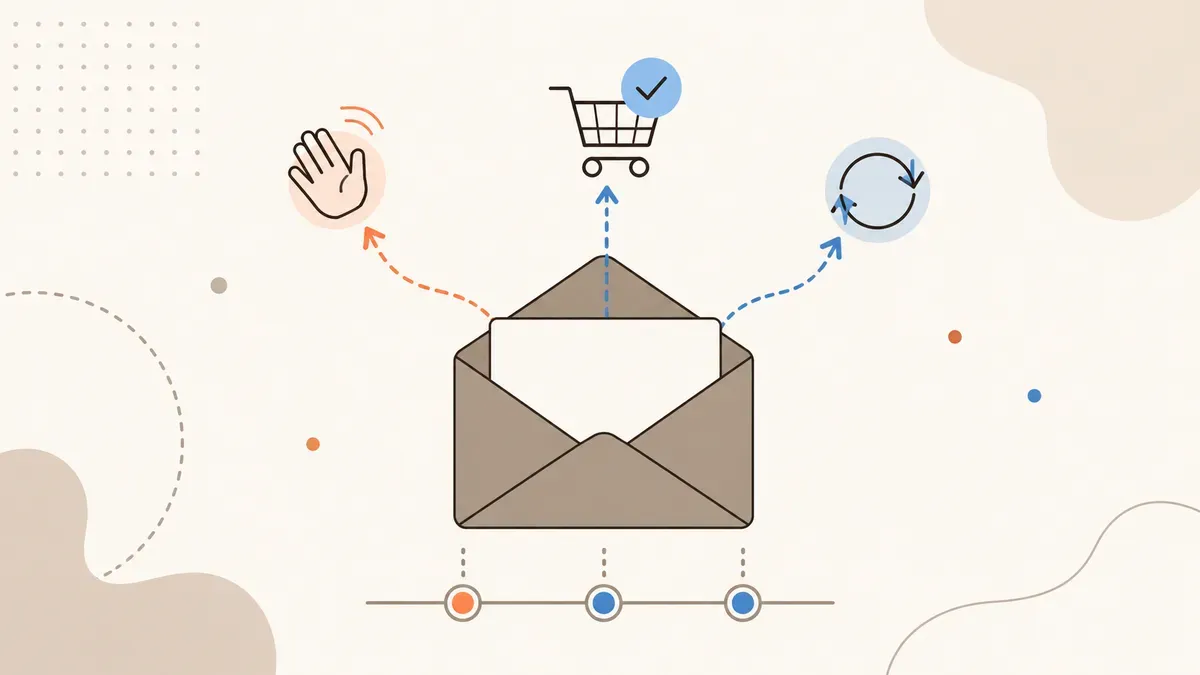
Email automation sends the right message to the right person at the right time – without you pressing "send." You define a trigger (someone signs up, abandons a cart, goes inactive), write the emails once, and the system handles delivery on schedule.
This is different from a newsletter. Newsletters go out to everyone at once. Automations respond to individual behavior. A new subscriber gets a welcome series. A shopper who left items in their cart gets a reminder 60 minutes later. A client who hasn't opened an email in 90 days gets a re-engagement nudge.
The impact scales without extra effort. Whether you have 200 contacts or 20,000, the same three flows keep working in the background. You build them once, optimize over time, and let compound returns do the rest. This is one of the core building blocks of any funnel and automation strategy.
Flow 1: The Welcome Series
Your welcome email is the highest-performing email you will ever send. Average open rate: 83.6%. Click-through rate: roughly 16%. Compare that to a typical newsletter at 21% open rate. The gap is enormous, and most SMBs waste it by sending a single "Thanks for subscribing" message with no next step.
A proper welcome series runs 3–5 emails over 10–14 days. Each email has one job.
The sequence
- Email 1 (immediately): Deliver the promised lead magnet or confirm the signup. Introduce yourself in two sentences. Set expectations for what they will receive and how often.
- Email 2 (day 2): Share your origin story or a core belief. Keep it short. The goal is connection, not a sales pitch. Link to one useful resource on your site.
- Email 3 (day 5): Address the biggest objection your prospects have. If you sell services, tackle the "why should I trust you" question with a case study or specific result. If you sell products, show social proof.
- Email 4 (day 8): Present your offer. Frame it around the problem you solve, not features. Include a clear call to action with a deadline or limited incentive.
- Email 5 (day 12): Follow up on the offer. Add a testimonial or FAQ. Remove friction. This email converts the people who were interested but needed one more nudge.
Benchmarks for a well-built welcome series: 83.6% open rate on email 1, tapering to around 40–50% by email 5. Conversion rate across the full series lands between 2.5% and 4% for service businesses, higher for e-commerce with a discount incentive. On a list of 500 new subscribers per month, that translates to 12–20 new customers without lifting a finger after setup.
If your website pulls in traffic but visitors leave without converting, the welcome series is your safety net. For more on plugging those leaks, see why your website isn't converting.
Flow 2: Inquiry and Cart Follow-Up
Someone filled out your contact form. Or added a product to their cart and left. They were interested enough to take action and then stopped. This is the warmest audience you have, and without a follow-up flow, you lose 70–80% of them permanently.
For service businesses (inquiry follow-up)
When someone submits a form on your site, trigger this sequence:
- Email 1 (within 5 minutes): Confirm receipt. Tell them exactly what happens next and when. "We received your inquiry and will respond within 4 business hours." Speed matters here. Businesses that respond within 5 minutes are 21x more likely to qualify a lead.
- Email 2 (24 hours later, if no reply): Share a relevant case study or testimonial. Keep it focused on their likely problem. "Last month we helped [similar business] achieve [specific result]."
- Email 3 (72 hours later, if no reply): Direct ask. "Still interested? Here's a link to book a 15-minute call." Include a calendar link. Remove every barrier to the next step.
For e-commerce (abandoned cart)
- Email 1 (60 minutes after abandonment): Simple reminder with product image. No discount yet. Subject line: "You left something behind." Open rate benchmark: 50.5%.
- Email 2 (24 hours): Address objections. Free shipping? Easy returns? Satisfaction guarantee? Click-through rate at this stage: roughly 6.25%.
- Email 3 (48–72 hours): Last chance with a small incentive (5–10% off or free shipping). Create urgency with a 24-hour expiry. This email recovers the fence-sitters.
Combined, a three-email cart abandonment sequence recovers 5–15% of abandoned carts. For an online shop doing EUR 10,000/month, that adds EUR 500–1,500 in monthly revenue from a flow you set up once.
Getting accurate data on which step loses the most visitors is critical. If your tracking is off, you are optimizing blind. We cover the most common pitfalls in the 7 most common tracking mistakes.
Flow 3: Re-Engagement and Win-Back
Every email list decays. Roughly 25–30% of your subscribers go inactive each year. They stop opening, stop clicking, and drag down your sender reputation. A damaged sender reputation means your emails land in spam – even for the contacts who want to hear from you.
A re-engagement flow targets contacts who have not opened or clicked in 90 days. The goal is binary: wake them up or clean them out.
The sequence
- Email 1 (day 90 of inactivity): Subject line that breaks the pattern. "We miss you" is overdone. Try something specific: "3 things changed since you last checked in" or "Quick question about [their interest]." Keep the body short. One clear link.
- Email 2 (day 97): Offer something exclusive. A resource, a discount, early access. Make it feel like a reward for re-engaging, not desperation.
- Email 3 (day 104): The breakup email. "We're going to stop emailing you unless you want to stay." Include a one-click "Keep me subscribed" button. This email often gets the highest open rate in the series because loss aversion is a powerful motivator.
Contacts who do not engage with any of the three emails get moved to a suppression list. Removing them improves your deliverability for the rest of your list. A clean list with 2,000 engaged contacts outperforms a bloated list of 8,000 where half never open.
Open Rates Compared: Automations vs. Newsletter
The performance gap between automated flows and standard newsletters is striking. Here is how the four main email types stack up:
Every automated flow outperforms the standard newsletter. The welcome series beats it by 4x. Even the win-back series – sent to your least engaged contacts – still outperforms a regular blast by 33%. The reason is timing and relevance. Automated emails arrive when the recipient expects them, tied to an action they just took.
Which Tool Fits Your Business?
You do not need an enterprise platform to run these three flows. But you do need a tool that handles triggers, delays, and conditional logic. Three options dominate the SMB market in 2026.
Brevo (formerly Sendinblue)
Best fit for EU-based businesses. Servers in the EU, GDPR-compliant out of the box, and the automation builder handles all three flows described above. Pricing starts at EUR 15/month. The free tier gives you 300 emails/day with basic automation. For most SMBs under 5,000 contacts, Brevo covers everything you need without the complexity of larger platforms.
ActiveCampaign
Stronger automation builder with branching logic, lead scoring, and CRM integration. If you run a service business with a longer sales cycle and need to assign leads to team members or track pipeline stages, ActiveCampaign is worth the higher price (starting around USD 29/month). The learning curve is steeper, but the flexibility pays off for complex workflows.
Mailchimp
Still widely used, but Mailchimp gutted its free plan in January 2026. The free tier now caps at 500 contacts with limited automation. Paid plans start at USD 13/month but charge by contact count, which gets expensive as your list grows. If you are starting fresh, Brevo or ActiveCampaign offer better value. If you already run Mailchimp and your list is small, migration may not be urgent – but keep an eye on the costs as you scale.
For e-commerce businesses comparing platforms, the choice of email tool often ties into your shop system. We break down the platform decision in WooCommerce vs. Shopify.
Common Mistakes That Kill Email Automation ROI
Setting up flows is step one. Keeping them effective requires avoiding a few traps that catch SMBs repeatedly.
1. Writing emails that sound like a press release
Your automated emails should read like a message from a person, not a corporation. Use "you" and "I." Keep paragraphs to 2–3 sentences. Write the way you would text a client, then polish it slightly. Emails that feel personal get 2–3x higher click-through rates than formal templates.
2. Skipping the double opt-in
In the EU, double opt-in is not optional – it is a GDPR requirement for email marketing. Beyond compliance, it filters out fake signups and bots. Your list stays cleaner, your open rates stay higher, and you avoid deliverability problems down the line. Every tool mentioned above supports double opt-in. Use it.
3. Setting and forgetting
Automations run in the background, which makes it easy to forget they exist. Review your flows every quarter. Check open rates, click rates, and conversion rates against the benchmarks in this article. If email 3 of your welcome series drops below 25% open rate, the subject line needs work. If your cart abandonment flow recovers less than 5%, test the timing or the incentive.
4. Sending too many emails too fast
A new subscriber who gets 5 emails in 3 days will unsubscribe. Space your welcome series over 10–14 days. Give cart abandonment 48–72 hours before the final nudge. Respect the inbox. Sending frequency is the number one reason people unsubscribe, ahead of irrelevant content.
Set up email automation for your business?
We build the three flows that work from day one – including GDPR-compliant setup.
Free consultation →