Lead Magnets 2026: What Still Works?
47.3% conversion rate for AI quizzes, 3–10% for PDFs. Which lead magnet formats work in 2026, why 79% of leads never convert, and what GDPR requires in the DACH region.
You built the PDF, created the landing page, embedded the form. Maybe even ran ads to it. And then: 47 downloads in three months, 3 with valid email addresses. The rest used gmail+spam@ or never came back.
That is not an outlier. The conversion rate for generic PDF downloads sits between 3 and 10% in 2026. In a world where ChatGPT can summarize any information in 30 seconds, nobody trades their email address for a 20-page ebook anymore. The good news: lead magnets still work. Just different ones than in 2023. And the data shows which.
Interactive lead magnets convert 2.4x better than PDFs
AI-adaptive quizzes
generic PDFs
due to missing follow-ups
Why traditional lead magnets stopped working
Three shifts changed the landscape between 2023 and 2026:
AI turned information into a commodity. Anyone can generate a "10-step guide" in seconds. The perceived value of compiled knowledge in PDF form has dropped to zero. Why would someone hand over their email address for it?
Attention spans keep shrinking. Cheat sheets under 500 words achieve a 41.7% conversion rate, outperforming longer formats by 29%. A 20-page guide gets downloaded but not read. A cheat sheet gets read but not downloaded – it has too little perceived exchange value.
Users expect personalization. One-size-fits-all content loses to tailored results. A quiz that tells you in 2 minutes where your specific problem lies beats any generic whitepaper. The numbers confirm it: quizzes convert 4–10x better than traditional PDFs.
The conversion rate hierarchy in 2026
The following numbers come from aggregated data across platforms like Interact (80M+ generated leads), cross-industry benchmarks, and A/B test analyses. They show a clear ranking:
The pattern is clear: the more interactive and personalized the format, the higher the conversion rate. Passive formats like PDFs and newsletter signups without incentives sit at the bottom.
What works in 2026: The top 5 formats
1. Quizzes and assessments
Quizzes lead the field by a wide margin. A standard quiz converts at 40.1%; with AI-adaptive logic (where follow-up questions adjust based on previous answers), that climbs to 47.3%. Interact alone has generated over 80 million leads through quiz-based magnets.
Why it works: a quiz delivers a personalized result. The email address does not feel like a payment but like the key to unlocking the result. For you as the provider, the quiz simultaneously delivers segmentation data. After the quiz, you know whether someone is a beginner or advanced, which problem is urgent, and which offer fits.
Examples for SMBs: "Which website type fits your business?" (5 questions, result via email), "How strong is your online marketing setup?" (scoring audit), "Which e-commerce stack matches your revenue?" Such a quiz is part of a well-planned funnel and automation strategy.
2. Free tools and ROI calculators
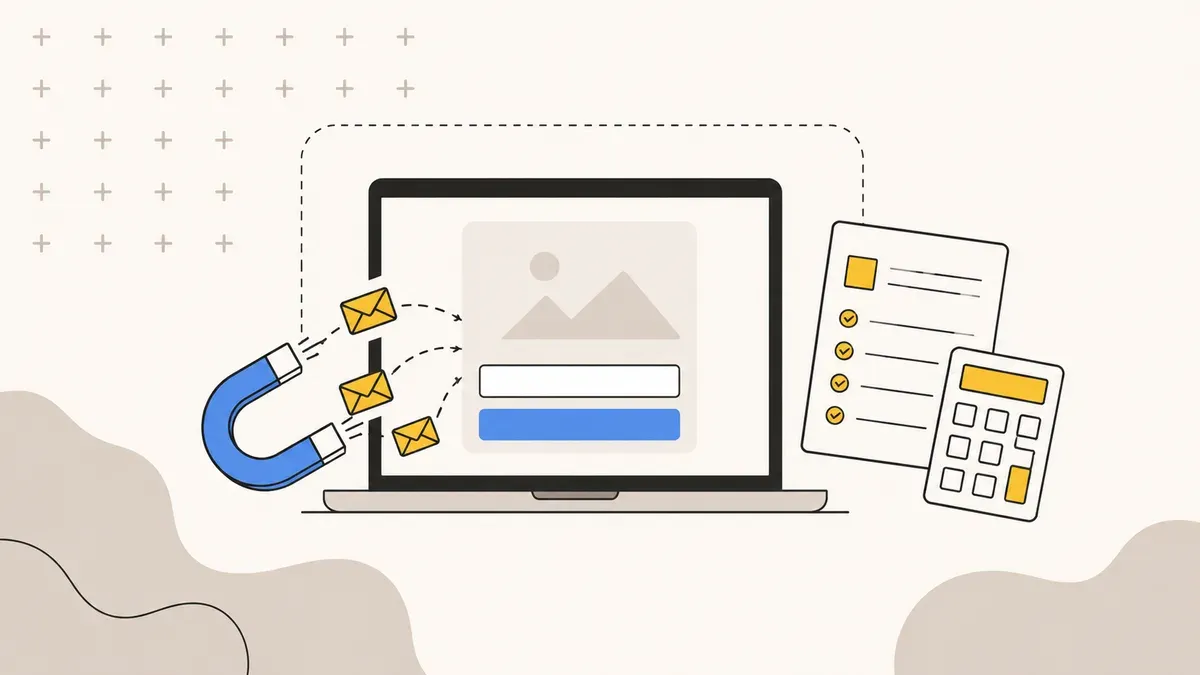
ROI calculators and free mini-tools achieve 30–50% conversion rates. The reason: they solve a concrete problem at the moment of use. A hosting cost calculator, a website ROI estimator, or an SEO audit tool delivers immediate value that no PDF can replace.
The effort is higher than creating a PDF. You need development capacity for the tool itself. But the long-term payoff is in a different league: a well-built calculator generates organic traffic and leads for months, while a PDF gathers dust after the launch burst.
3. Cheat sheets and short formats
Surprising to many: cheat sheets under 500 words outperform longer formats by 29% in conversion rate (41.7% vs. 32.3%). The reason is simple – users trust that they will actually use a short document. With a 40-page ebook, everyone knows it will be forgotten in the Downloads folder.
The format works particularly well for checklists, templates, and quick-reference cards. A one-page "WordPress Launch Checklist" converts better than a "Complete Guide to Launching WordPress" spanning 25 pages.
4. Micro-courses and webinars
Webinars and short email courses (3–5 lessons) achieve a 27.4% conversion rate. They work especially well for complex services where the prospect needs multiple touchpoints before buying.
A 5-part email course on "Your First Funnel in 5 Days" does two things at once: it delivers value and builds trust. And it gives you five opportunities to position your offer instead of one.
5. Audits and industry-specific checklists
For service businesses (agencies, consultants, tradespeople), audit-based magnets convert at 18–32%. "Let us evaluate your website in 5 minutes" is a strong hook because it serves two needs: curiosity ("How good am I?") and urgency ("What do I need to fix?").
The range is wide because conversion depends heavily on specificity. A generic "website audit" converts at 18%. A "SEO audit for trade businesses in the DACH region" hits 30%+. The narrower the audience, the higher the rate. This same principle explains why websites with clear audience targeting perform better overall – more on that in our article on why your website is not converting.
Interactive vs. static: The comparison
The data boils down to one number: interactive lead magnets convert 2.4x better than static PDFs. The differences are not marginal – they are structural.
| Criterion | Interactive (Quiz, Tool, Calculator) | Static (PDF, Ebook, Guide) |
|---|---|---|
| Conversion rate | 26–47% | 3–10% |
| Segmentation data | Yes, automatic | None (email only) |
| Perceived value | High (personalized result) | Low (AI can do that too) |
| Creation effort | Medium to high | Low |
| Long-term performance | Stable (organic traffic) | Declining after launch |
| Follow-up quality | Segmented, relevant | Generic |
The higher creation effort for interactive formats pays off: leads are more qualified, follow-up sequences can be segmented, and long-term performance stays stable. How you turn those leads into customers is covered in our article on email automation for SMBs.
After the opt-in: Why 79% of leads never become customers
The lead magnet is only half the work. 79% of all leads never convert to paying customers – and the main reason is not lack of interest but missing follow-up sequences.
The numbers are unambiguous:
- $42 return per $1 invested – email marketing has the highest ROI of all digital channels
- Welcome series generate 22x more revenue per email sent than standard newsletters
- Segmented lists drive 760% more revenue than unsegmented broadcasts
A quiz that delivers segmentation data is worthless if the same generic email sequence goes to everyone afterward. The combination makes the difference: a lead magnet that segments + a follow-up sequence tailored to the segment.
In practice: someone who clicks "I don't have a website yet" in the quiz receives different emails than someone who selects "My website performs poorly." The landing page converts the visitor into a lead, the email sequence converts the lead into a customer. Both need to be in place.
GDPR: Building lead magnets that are legally compliant
In the DACH region (Germany, Austria, Switzerland), stricter rules apply than in the US or UK. If you deploy lead magnets, three things matter:
Double opt-in is mandatory
In Germany, the double opt-in process (DOI) is effectively required. Without DOI, you cannot prove consent in a dispute. Technically it works like this: user enters email, receives a confirmation email, clicks the link, only then gets added to the list. Every reputable email marketing platform (Brevo, Mailchimp, ActiveCampaign) supports this.
The "Kopplungsverbot" (coupling prohibition – Art. 7(4) GDPR)
The coupling prohibition states: you may not make the provision of a service conditional on consent to the processing of additional data. In practice this means:
- The lead magnet download must not be tied to newsletter consent
- Separate, unchecked checkboxes for different purposes
- One checkbox for "Yes, I want to receive the lead magnet" and a separate one for "Yes, I also want the newsletter"
Many lead magnet funnels in the DACH region violate this rule. The email address is collected for the download, and then contacts automatically end up on the newsletter list. This is legally problematic.
Gated content does not equal marketing consent
Just because someone provided their email for a download does not mean you can send them a nurture sequence. Consent for the download covers sending the download – nothing more. For follow-up emails, you need separate, active consent.
This sounds like an obstacle but works as a quality filter: someone who consciously checks both boxes is a more qualified lead than someone who just wanted the download quickly. Your email sequence conversion rate improves because only interested contacts land on the list.
Lead magnets for SMBs: What you can implement this week
You do not need a large budget or a dev team. Here is a realistic sequence, sorted by effort:
Week 1: Cheat sheet or checklist. Take your most-read topic, distill it to one page, build a landing page with a form. Effort: 4–6 hours. Expected CR: 25–40%.
Week 2–3: Quiz with 5–7 questions. Use tools like Interact, Typeform, or Outgrow. Connect the results to your email tool so different outcomes trigger different follow-up sequences. Effort: 1–2 days. Expected CR: 35–47%.
Month 2: ROI calculator or mini-audit tool. This requires development capacity but pays off long-term. An industry-specific calculator attracts organic traffic and generates leads consistently for months. Effort: 3–5 days of development. Expected CR: 30–50%.
The most important step comes after the lead magnet: the automated email sequence that turns the lead into a customer. Without this step, 79% of your leads remain worthless, no matter how well the magnet converts.
The right lead magnet for your business
Not every format fits every business model. The choice depends on three factors: your target audience, your sales cycle, and your capacity.
Local service providers (tradespeople, consultants, agencies): audit checklists and industry-specific quizzes. "How strong is your marketing setup?" delivers segmentation data to you and gives the prospect a starting point for a conversation. The conversion data from a well-structured funnel strategy speaks for itself.
E-commerce: product finder quizzes and discount-for-email work, but note – discount codes perform worst among all lead magnet types in benchmarks. Better: a quiz that leads to the right product while collecting the email along the way.
SaaS and digital products: ROI calculators and free tool versions. "Calculate how much you save with X" is the strongest hook because it ties the result to a concrete number.
The ground rule: the more specifically the lead magnet targets your audience, the better it converts. A "marketing guide for everyone" struggles at 5% CR. An "SEO checklist for WooCommerce shops with 50–200 products" hits 30%+. More on why content specificity matters in our article on content strategy for SMBs.
Need a lead magnet + funnel?
We build lead magnets that convert and the automation sequence behind them. From quiz logic to segmented email series.
Free initial consultation →