Case Study: A Ride-Share Hub for Retreat Participants
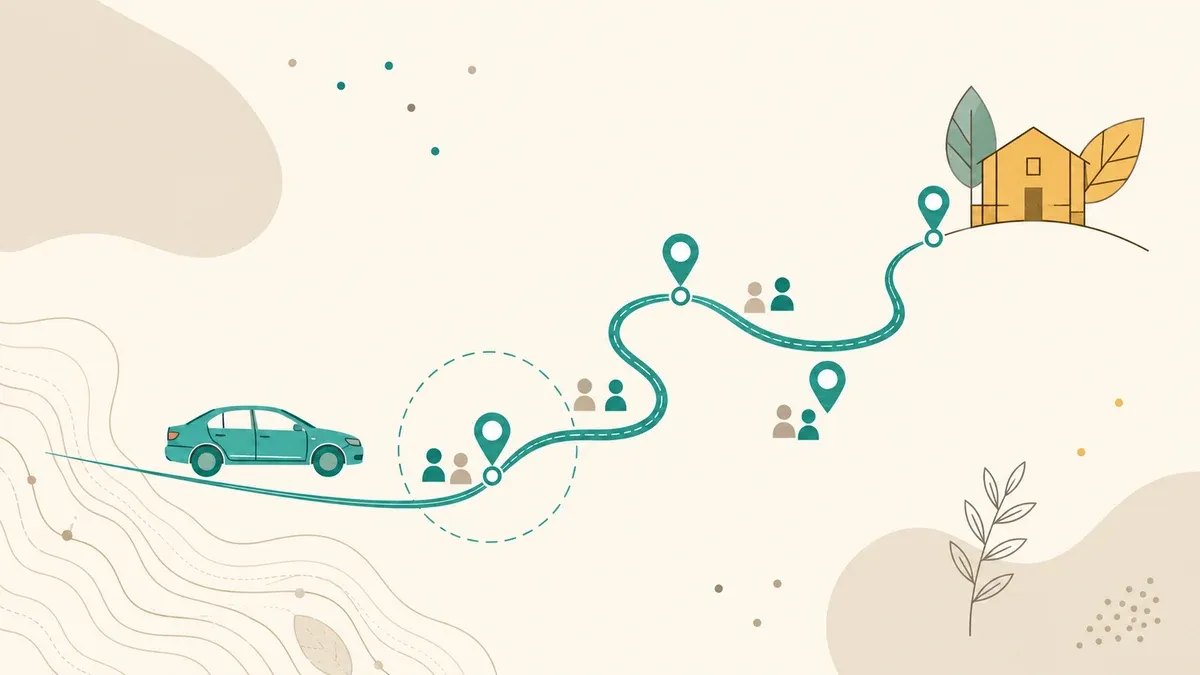
449 participants, 2 targeted emails: how an idea became a community platform for shared retreat travel, powered by accurate numbers from each participant's local area.
A retreat provider came to us with a simple observation: their participants travel in from all over the German-speaking region, often alone in the car, often in the same direction to the same monastery. The idea was a ride-share hub where they team up. We did not build a form for it. We built a small community platform. And the part that decides whether it actually gets used is not the feature list, it is two well-timed emails.
This piece walks through the path from idea to concept and mockup to a finished portal. Then the real lever: why the right messages to the right people move more than any set of features. The numbers come from the live project, and we leave out the portal's name on purpose.
In short
- A custom platform instead of a plugin, because the requirements (retreats pulled automatically from the shop, separate outbound and return trips, protected contact details, accessibility) went beyond any off-the-shelf tool.
- Not a form, a portal: browse rides per retreat, request a seat, confirm. Passwordless login, designed mobile first.
- Privacy built in: email and phone become visible only after a request is confirmed, never before. Old entries delete themselves automatically.
- The usage lever is two emails: one at booking, one around three weeks before travel with accurate numbers from the participant's own postal-code area.
- First send: 449 participants matched automatically from 2,470 orders, 72 personal invitations in the first run.
The idea: travel together instead of alone in traffic
The provider runs multi-day retreats, mostly in monasteries and country houses, often far from the nearest train station. The participants are mostly women between 35 and 65, coming from Hamburg, Munich, the Ruhr area, Austria and Switzerland. Many drive their own car, many alone, and some of them start in the same area heading the same way.
The owner wanted to bring these people together. It saves fuel and stress, it is better for the environment, and it fits the spirit of a retreat: you get to know each other on the way there. One condition was set from the start. The audience is not tech-savvy. Every extra hurdle, every password, every unclear button costs participation. Whatever we built had to feel like a quick tap, not like software.
Why not an off-the-shelf plugin?
The obvious question first: isn't there a plugin for this? For a ride-share network inside an existing shop there are barely any usable ready-made tools, and the few attempts fail on the concrete requirements. The retreats should not be maintained twice, they should flow in automatically from the existing WooCommerce shop. Outbound and return trips had to be separate, because many arrive the day before. Contact details could not sit out in the open. And the whole thing had to survive a later tech change without a rebuild.
This is the same trade-off as with any membership area between plugin and custom: a plugin installs fast, but it ties you to someone else's update cycle, monthly licences and exactly the features the vendor allows. A custom, lean application costs more effort up front and almost nothing afterwards, and it does precisely what is needed.
| Criterion | Off-the-shelf plugin | Custom platform |
|---|---|---|
| Maintaining retreats | usually manual, duplicated from the shop | pulled automatically from the shop |
| Contact-data protection | rarely fine-grained | visible only after confirmation |
| Running cost | monthly licence, ongoing | hosting, nothing else |
| Future-proofing | tied to the vendor | survives the tech change |
For a feature that belongs to the core of the offering and that you want to run long term, the decision clearly favours the custom route. That is exactly what our custom web applications and tools are for.
From concept to mockup
The first draft was deliberately not a form with a list underneath. Someone looking for a ride does not want to fill in a field, they want to see who is already driving and request a seat with one click. So it became a small portal with clear paths: offer a ride, find a seat, manage requests.
In the mockup we sketched the screens and played through the flows before a single line of code existed. Two things led the way. First, mobile first, because the audience does almost everything on the phone. The key actions sit at the bottom, within thumb reach. Second, calm on screen: one main action per screen, large type, clear colours instead of busy tiles.
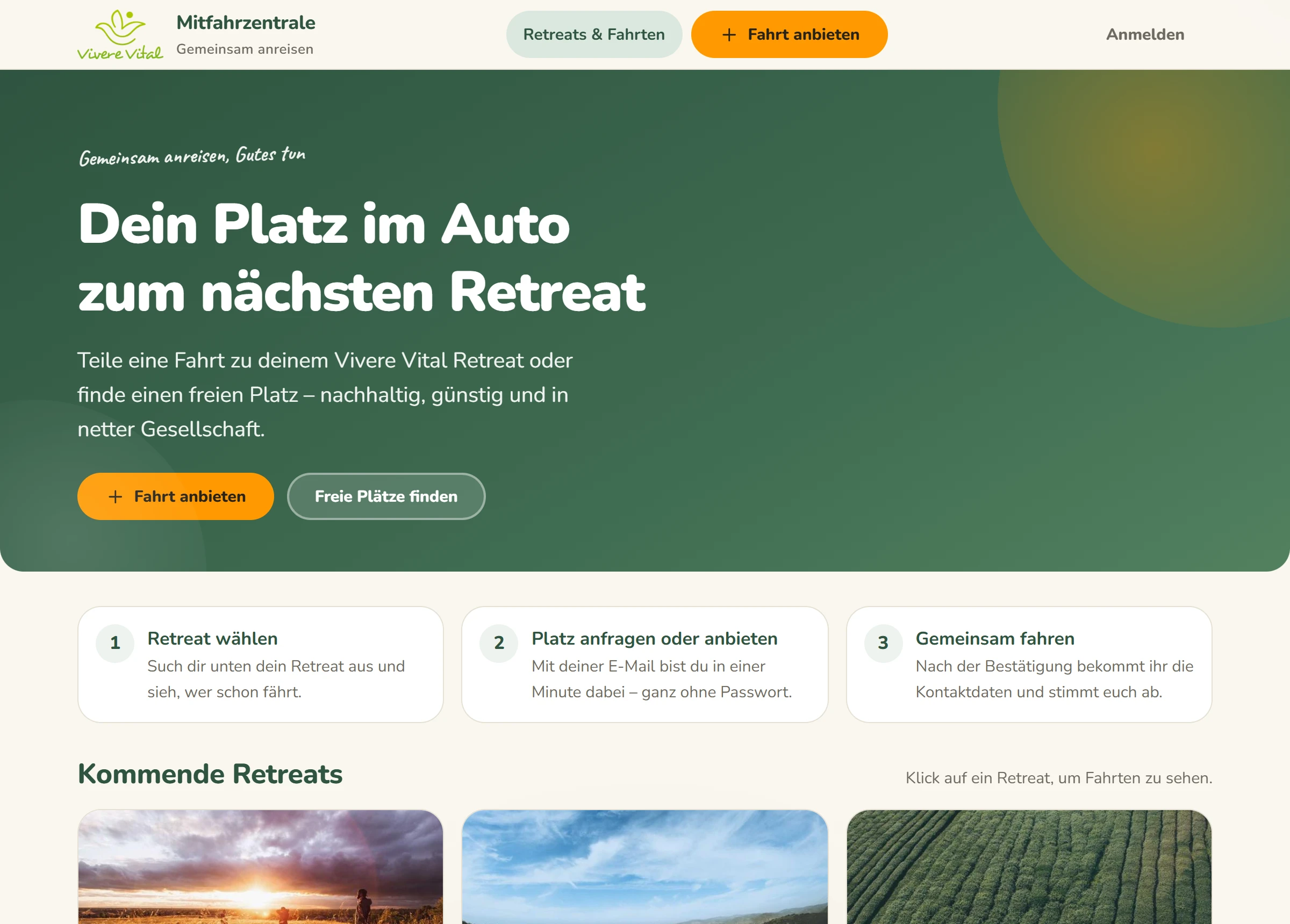
The home page: one clear statement, three steps, and the upcoming retreats straight from the shop.
What the platform does
The mockup turned into a portal that sticks to the essentials. For each retreat you see every offered ride with first name, departure location and free seats. What you do not see: email or phone number. Those appear only once the driver has confirmed a request. This contact-data gate is the heart of the privacy design, and it doubles as a trust win: nobody scatters their address across the web.
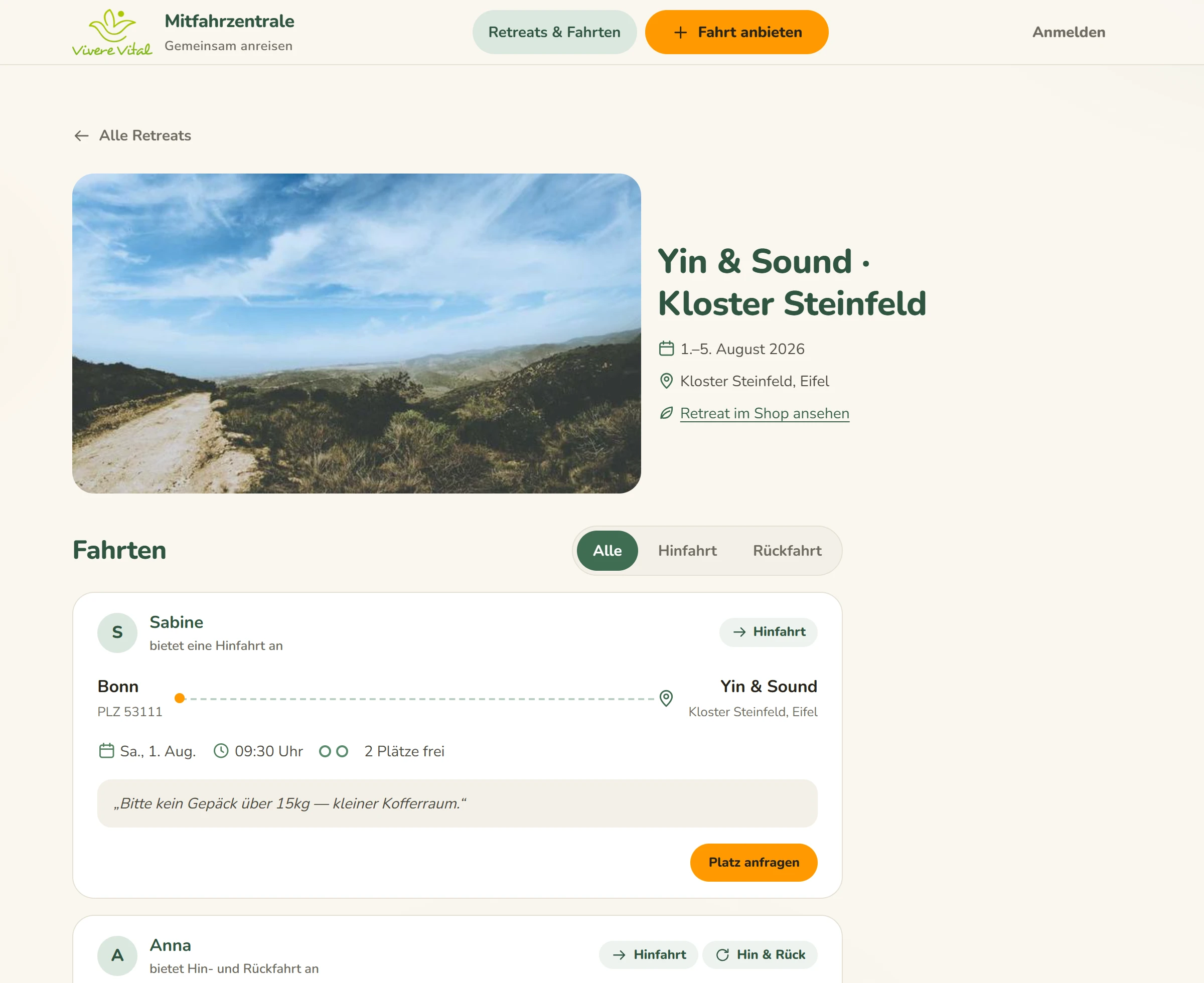
Rides per retreat, split into outbound and return. A seat is requested with one click, without giving away any contact details.
The building blocks at a glance
- Retreats straight from the shop: new dates appear on their own, day workshops and online courses are filtered out.
- Outbound and return separate: if you arrive the day before or head back later, you enter each trip on its own.
- Request and confirmation: the driver decides who joins. Only then are contact details shared.
- Passwordless login: one click on the link in the email is enough. No account, no forgotten password.
- Accessible and mobile: large buttons, good contrast, usable with keyboard and screen reader.
- A reminder before the trip and automatic deletion of old entries after the retreat.
The real lever: the right emails
Now the most important part, and the one easiest to underrate. A beautiful platform that nobody knows about moves nothing. The offering is hard to promote openly, because only actual participants should join, no outside traffic. A menu item or one line in a product description gets lost. The path runs through targeted emails to exactly the people who already booked a retreat.
It is two messages, no more. The first arrives shortly after booking and says, warmly: you are in, take a look at the ride-share hub. No pressure, one button, done.
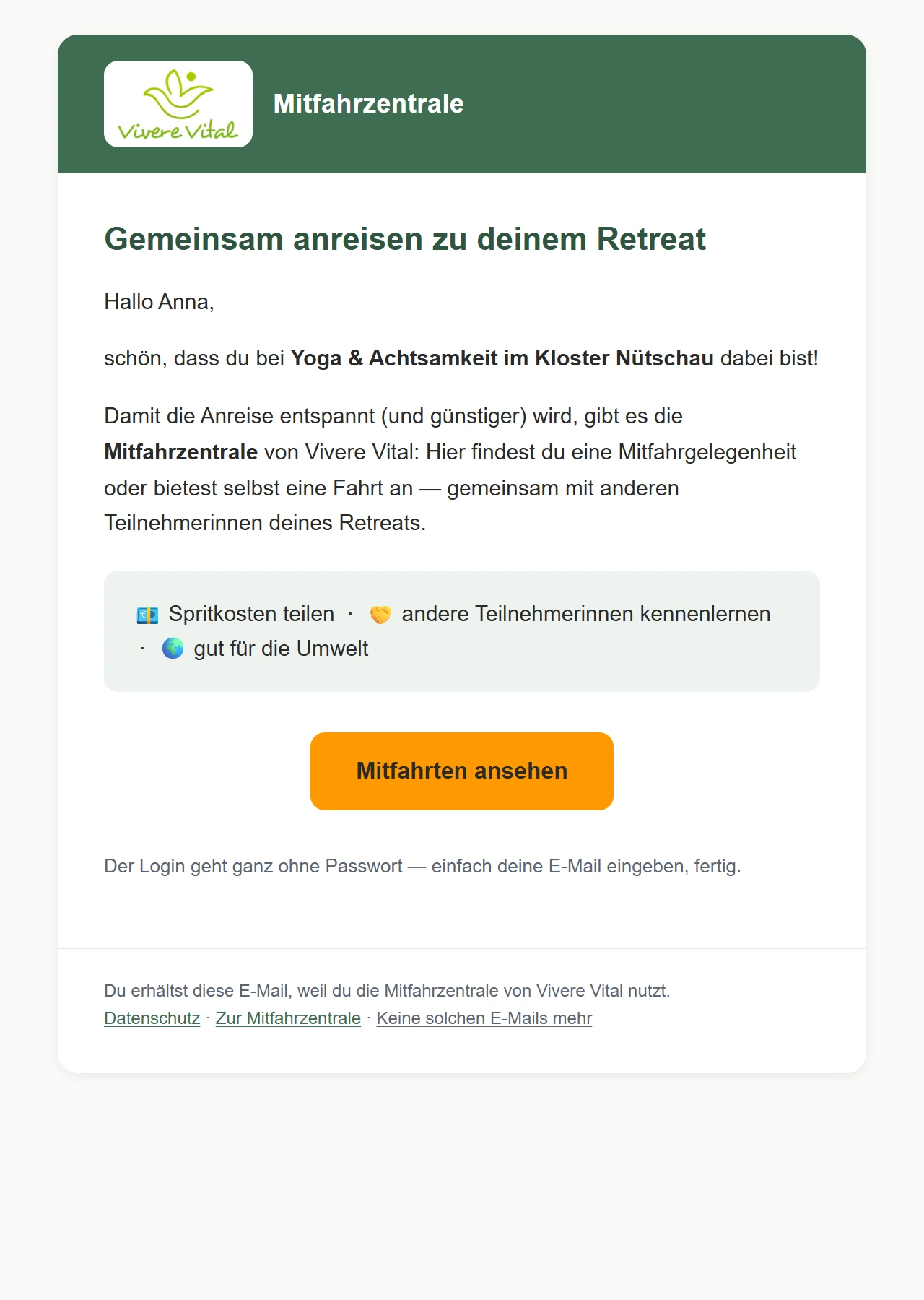
Email 1, at booking: a warm pointer, no sales pressure.
The second message is the interesting one. It arrives around three weeks before travel, right when trip planning kicks in. And it is personal, with accurate numbers from the participant's postal-code area. If matching rides exist, it says in effect: rides have already been offered near you, take a look. If there is no ride yet but other participants nearby, the message flips it around and asks: others near you are heading there too, would you offer a ride?
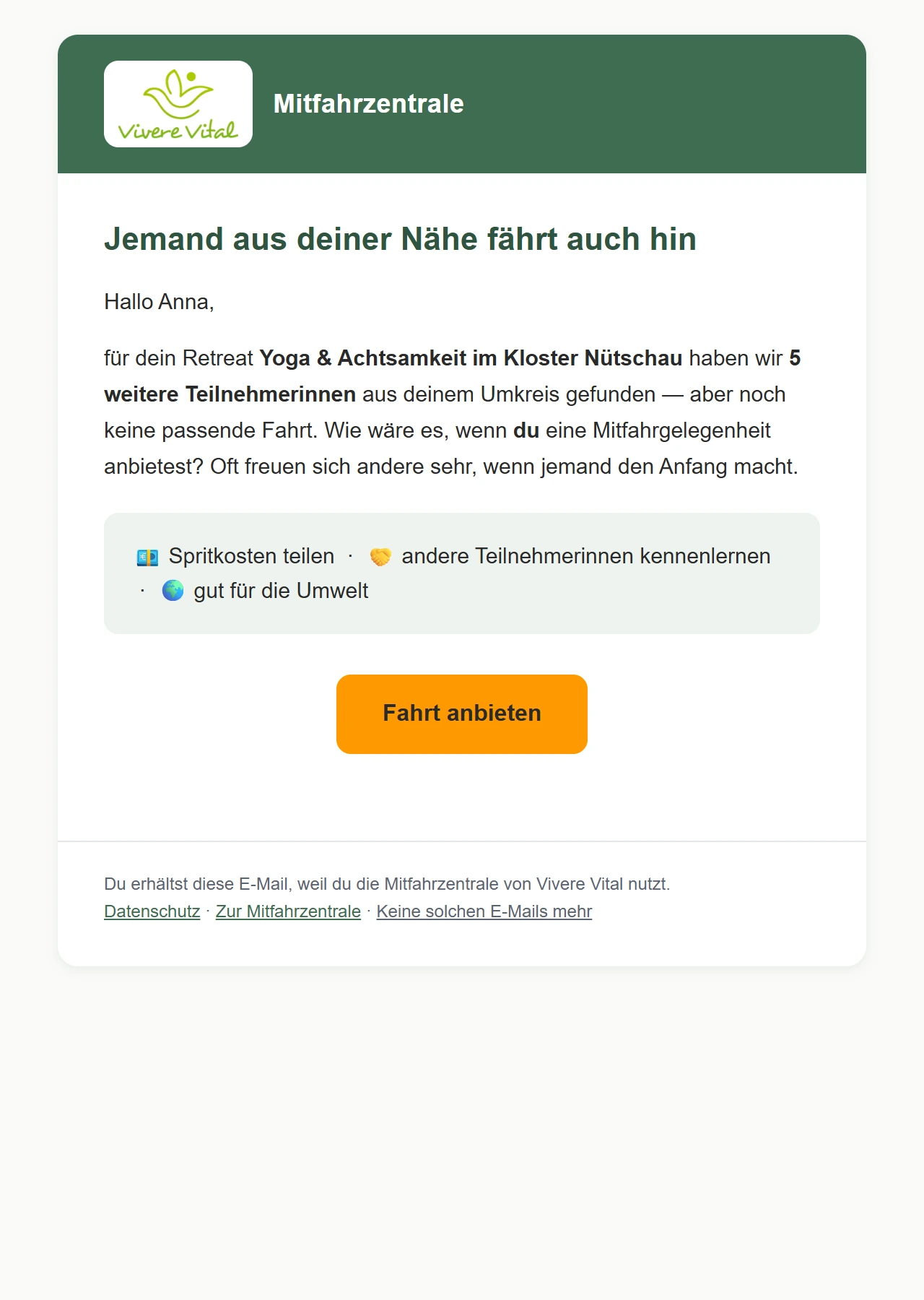
Email 2, around three weeks out: an accurate number from the local area and a concrete nudge.
One principle mattered here: no made-up numbers. If a number is shown, it is correct. That decides the credibility of the whole mechanic. At the first send there were naturally no offered rides yet, so almost every invitation went out with the nudge to offer one. This bootstrap pulls the first rides into the system, and from there the message flips on its own to the version with matching rides.
The first send: 72 invitations, 58 of them nudging the recipient to offer a ride. Once the first rides are in, the blue bar grows.
Legally the send rests on legitimate interest, because every message relates directly to the recipient's own booking and travel. Each email carries a clear unsubscribe link that switches off only these invitations, never the important system messages like the login. Whoever unsubscribes gets no further invitation. You know the pattern from any solid email automation for SMBs: few, relevant messages at the right time beat any newsletter barrage.
What you can take from this
Two lessons sit in this project, retreats aside. First: when a feature belongs to the core of your offering, the custom route almost always pays off. It costs more thinking up front and barely anything afterwards, and it ties you to no one. Second, and this is the bigger point: the tech is half the job. Whether a platform lives is decided by whether the right people get a concrete, tangible nudge at the right moment. Privacy and accessibility are not a chore here, they are precisely what builds trust, especially with an audience that tends to avoid technology.
Frequently asked questions
Why a custom platform instead of a plugin?
Because the requirements went beyond any ready-made tool: retreats pulled automatically from the shop, separate outbound and return trips, protected contact details and a build that survives a later tech change. A plugin ties you to someone else's update cycles and ongoing licences, a custom application does exactly what is needed and costs almost nothing after launch.
How is privacy protected?
A person's email and phone become visible only once a request is confirmed; before that you see only first name and departure location. The invitation send rests on legitimate interest with a clear unsubscribe link, and old rides and booking data delete themselves after the retreat.
How do participants reach the platform at all?
Through two targeted emails to people who already booked a retreat: one at booking, one around three weeks before travel with accurate numbers from their own area. That keeps the hub among actual participants, with no open promotion.
What does a solution like this cost?
It depends on scope: data sources, number of flows, email logic and design drive the effort. A lean, clearly scoped platform like this stays manageable because it concentrates on a few well-built features. The clearest way to work it out is a short conversation about your specific case.
Got an idea no plugin covers?
We build lean, custom web applications that solve exactly one problem, work cleanly with your shop or website, and belong to you. Let's talk about your idea.
Discuss your project