How Do I Get Recommended by ChatGPT? 8 Signals + Self-Test
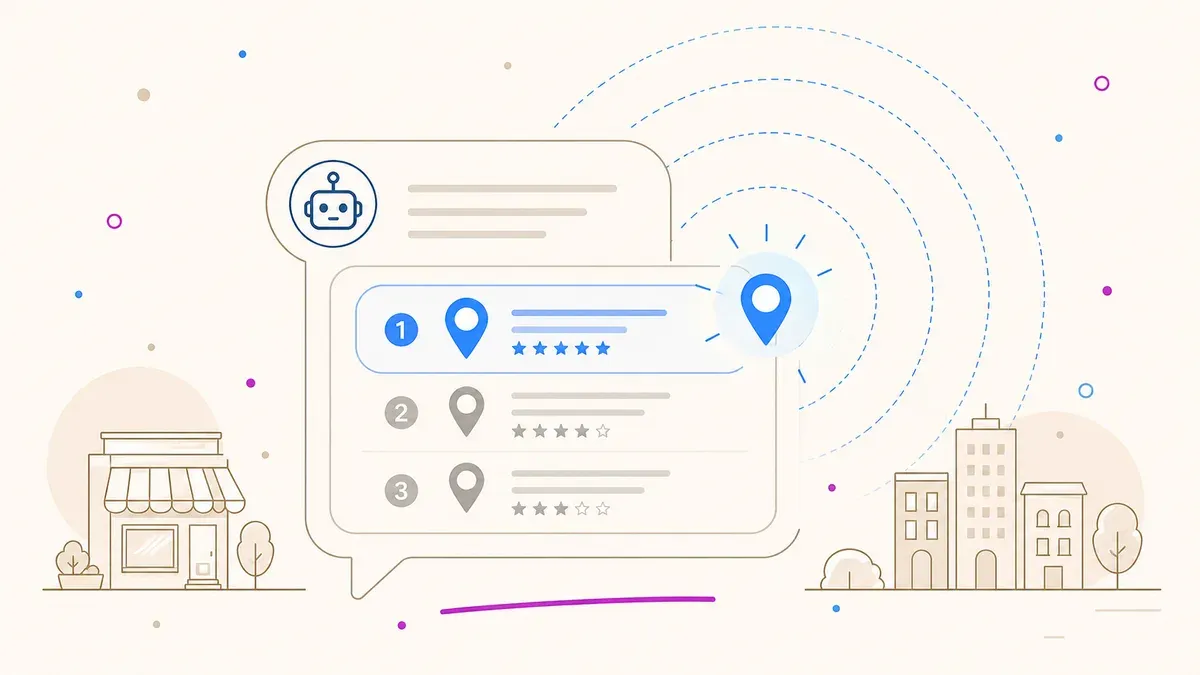
Only 1.2% of local businesses get recommended by ChatGPT (SOCi 2026). 8 signals, a 30-minute self-test, and concrete steps to land in AI answers.
You get recommended by ChatGPT when the AI understands your business as a clear entity, finds your data identical everywhere, can crawl your site cleanly on a technical level, and enough independent third-party sources mention you. It is not a single trick but a combination of consistent core data (NAP), permitted crawl access for GPTBot, structured data in static HTML, answers that sit right at the top of the page, and reputation signals like reviews and industry-portal mentions. Those who deliver these signals show up in the answers. Those who do not stay invisible - and see the competition instead.
This is exactly where the problem lies for most SMBs in the DACH region. Only 1.2% of local businesses get recommended by ChatGPT at all (SOCi 2026 Local Visibility Index, 350,000 locations), while 35.9% still appear in the classic Google Local Pack. So when ChatGPT names your competitors and skips you, it is not because the AI dislikes you but because it lacks the signals to understand and trust you. In this post you get the eight signals that decide the outcome, a 30-minute self-test to measure your current visibility, and a prioritized plan for where to start.
In short
- Data consistency first: Name, address, phone (NAP) must be identical across your website, Google Business Profile, Bing Places, and directories. This is the foundation, and nothing else works without it.
- Open up crawl access: Allow GPTBot and OAI-SearchBot in your robots.txt and be indexed in Bing Webmaster Tools. ChatGPT Search pulls its index from Bing.
- Structure instead of JavaScript: Static HTML with Schema.org is parsed correctly by AI 94% of the time, JavaScript-rendered pages only 23% (leapd.ai). FAQ schema gives a +40% citation weighting with ChatGPT.
- Answer up top: The first third of a page delivers 44.2% of all LLM citations (Zyppy). Answer the core question in the first 200 words.
- Third-party sources count most: 89% of AI citations come from independent sources (Goodfirms 2026). Industry portals, reviews, and mentions weigh more than your own website.
Only 1.2% of local businesses get recommended by ChatGPT. In the DACH region, 75% of AI referrals come from exactly this system.
Why ChatGPT names your competition and not you
Imagine someone asks ChatGPT: "Which web agency for SMBs in the Munich area would you recommend?" At that moment, the AI does not have a search engine list in front of it to click through. It draws on what it "knows" about the candidates, or on what it can retrieve through its web connection in that moment. It names the businesses it recognizes as clearly defined entities, whose data is consistent, and that other sources have written about positively. Without this profile, you drop out of the answer. The AI does not guess; it selects from what is verifiable.
The second reason is technical. ChatGPT Search uses the Bing index as a gatekeeper (leapd.ai). If your site is not cleanly indexed in Bing or GPTBot is locked out, you simply do not exist for the system - no matter how good your content is. On top of that: of the pages ChatGPT actually retrieves for a commercial query, only around 15% are cited (leapd.ai). The filter is tight. Your competition passes through it because they deliver the signals that get past this filter.
The third reason is trust via third parties. 89% of AI citations come from third-party sources, not from the company's own website (Goodfirms 2026). Brands are cited 6.5 times more often via such third-party sources. When your competition is written about in industry portals, comparison lists, and forums, a picture of authority builds up for the AI. The web is silent about you, so the AI is silent about you too.
How big the gap really is: the numbers
Before we get to the levers, it is worth a sober look at visibility across the platforms. The following values show how rarely local businesses land in a recommendation per system at all. They make clear that ChatGPT is by far the strictest gatekeeper.
The share of local businesses that get recommended drops from 35.9% in the Google Local Pack to 1.2% with ChatGPT (SOCi 2026, 350,000 locations). At first this seems discouraging. But it also means the field is thinly occupied. Whoever delivers the right signals now competes with very few others for the spot in the answer. The early lead is substantial, because most SMBs have not even started yet.
And the effort pays off, because traffic from these systems behaves differently. In the DACH region, 75.39% of AI referrals come from ChatGPT and 21.66% from Perplexity (feller.systems Q1 2026), while Perplexity sits under 5% globally. That is a DACH peculiarity. AI traffic grew 527% year over year in the same period, conversion from LLM referrals sits at 18%, and AI users stay on average 11:19 minutes, 76.7% longer than visitors from organic search. This traffic is small but high in quality and growing fast.
In parallel, what you get from classic search is shrinking. AI Overviews appear on around 20% of all German search queries (Sistrix, Feb 2026) and cost roughly 265 million clicks per month in Germany in total, a drop of 6.6% in organic clicks (Sistrix). The click-through rate on position 1 falls from 27% without an AI Overview to 11% with one, a decline of 59% (Salzerdigital/Sistrix). Whoever relies solely on the blue link loses reach that resurfaces elsewhere: in the AI answers. This is exactly why optimizing for it is no longer a nice-to-have.
What are GEO, GAIO, and LLMO anyway?
Several abbreviations circulate for what is described here. GEO stands for Generative Engine Optimization, GAIO for Generative AI Optimization, and LLMO for Large Language Model Optimization. At their core they mean the same thing: positioning your content and your business so that generative AI systems understand you, trust you, and cite or recommend you in their answers. It is the evolution of SEO for a world in which no longer just a list of links but a finished answer is delivered.
The most important difference from classic SEO: with a search engine you want to rank in first place. With AI you want to be part of the answer, and the answer is often consumed without a click. In Google AI Mode, the zero-click rate sits at 93% (Conductor via feller.systems). Your visibility therefore arises in the mention itself, not only in the click. If you want to go deeper into the fundamentals, you can find it covered in detail under GAIO - optimizing for AI search. The good news for practice: the levers overlap strongly with good SEO for SMBs, so you are not building from zero.
The 8 signals that decide your recommendation
These eight signals work together. You cannot maximize a single one and ignore the rest. But they have an order, because some are foundation and others build on top of it. Go through them top to bottom.
Signal 1: Data consistency (NAP)
NAP stands for name, address, phone number. These three pieces must be exactly identical everywhere: on your website, in the Google Business Profile, in Bing Places, and in every directory where you are listed. Even discrepancies like "Strasse" versus "Str." or an old phone number in a forgotten entry confuse the AI. It then cannot decide with confidence whether this is one and the same business, and leaves you out when in doubt.
How to do it: Create a table with every place where your business appears online. Enter the respective spelling of name, address, and phone. Correct every discrepancy to one single binding form. This is an afternoon's work and the foundation for everything else. Without clean NAP data, every later optimization fizzles out.
Signal 2: Crawl access
If the AI providers' bots are not allowed to retrieve your site, you cannot be cited. In your robots.txt, GPTBot (for training) and OAI-SearchBot (for ChatGPT Search) must be explicitly allowed. Many sites lock these bots out by accident because plugins or security settings block them across the board. Just as important: since ChatGPT Search builds on the Bing index, you need to be cleanly indexed in Bing Webmaster Tools, not only with Google.
How to do it: Open your robots.txt (usually at yourdomain.com/robots.txt) and check that there is no Disallow rule for GPTBot or OAI-SearchBot. Set up an account in Bing Webmaster Tools, submit your sitemap, and check whether your most important pages appear in the Bing index. Both together take 30 to 60 minutes. How to steer bots in a targeted way and make your site AI-ready is covered in depth in the post on Agentic Browsing & llms.txt.
Signal 3: Entity clarity
The AI thinks in entities, meaning in clearly identifiable things: this business, this person, this service. For it to grasp you as a clear entity, you need a consistent self-description. Who are you, who do you work for, what exactly do you do? This description should carry the same core statement on your About page, in your Google Business Profile, and everywhere else. For person-based brands, a clear personal reference helps, because the AI links people and businesses to each other.
How to do it: Formulate a clear one-sentence profile of your business ("X is a Y agency from Z for target group A"). Use this statement consistently on the About/grounding page, in profiles, and in description texts. Check whether a Knowledge Panel exists for your brand on Google, and work toward it. This is medium effort, because it has to be aligned across several places.
Signal 4: Structured data and llms.txt
AI systems understand structured data far better than unstructured running text. Static HTML with Schema.org markup is parsed correctly 94% of the time, JavaScript-rendered content only 23% (leapd.ai). This is the single biggest technical lever there is. The relevant schema types are Organization, LocalBusiness, FAQPage, and Article. Pages with FAQ schema get a 40% higher citation weighting with ChatGPT (leapd.ai). On top of that comes the llms.txt at the root of your domain, a file that offers AI systems the most important content of your site in bundled form.
How to do it: Make sure your central content sits in the HTML server-side and is not loaded in later via JavaScript. Add Schema.org markup for your business (Organization/LocalBusiness), for every article (Article), and for your FAQ sections (FAQPage). Place an llms.txt in the root directory. This is work for the first week and pays directly into parsability.
Signal 5: Answer-first content
The first third of a page delivers 44.2% of all LLM citations (Zyppy analysis). Translated, this means: answer the actual question right at the top, in the first roughly 200 words, in clear sentences. Do not push the answer behind introduction, storytelling, and warm-up text. The AI needs the citable core early and compact. After that you can go into depth. A clear structure with H2 and H3 headings that mirror real search queries helps the AI find the right passages.
How to do it: Write every important page on the inverted-pyramid principle. The direct answer at the top, the reasoning and details below. Use an FAQ format for recurring questions and phrase headings the way people actually ask. This is work for the first week and takes effect immediately, because it concerns exactly the passages that get cited most often.
Signal 6: Reviews and sentiment
Reputation is a trust signal for the AI. Businesses with over 80% positive sentiment get recommended 3 to 5 times more often (dominikkienzle.de / BrightLocal). What counts is not only the star count but the freshness: 74% of users pay attention exclusively to reviews from the last 90 days. An old top review from two years ago therefore weighs less than a steady stream of fresh, positive feedback. The goal should be over 4.5 stars on average, combined with a continuous inflow of reviews.
How to do it: Ask satisfied customers systematically and promptly for a review after every job. Respond to every review, including critical ones, factually and constructively. Make sure the review stream does not dry up, because the last 90 days count disproportionately. This is an ongoing task with no end date.
Signal 7: Mentions and digital PR
Here lies the biggest underestimated lever. 89% of AI citations come from third-party sources (Goodfirms 2026), and domains with more than 32,000 referring domains are cited 3.5 times more often by ChatGPT. For most SMBs this number is utopian, but the direction is right: the more independent, credible sources mention you, the more authoritative you appear to the AI. These are industry portals, sector listings, guest articles, interviews, and mentions in the local press.
How to do it: Identify the five to ten most important industry portals and directories in your sector and ensure clean entries. Offer trade media guest articles or expert assessments. Earn mentions through substantive content rather than bought links. This is work for months 2 to 4, because relationships and publications take time, but it is the lever that detaches you from your own website and brings you into the world of third-party sources.
Signal 8: Wikipedia/Wikidata, Reddit, and recency
A Wikidata entry explains a considerable share of LLM visibility in individual sectors, up to 49.9% for furniture, 42.3% for hotels, 42.9% for ERP (OppAlerts LLM Ranking Factors, May 2026, 105,000+ prompts). At the same time, only 5.5% of domains have a Wikidata entry at all. This is a rare opportunity with high explanatory value. On top of that comes Reddit: with Perplexity, 46.7% of citations come from Reddit (leapd.ai), which Perplexity cites 82% from content of the last 30 days. Recency beats everything here.
How to do it: Check whether your business meets the relevance criteria for a Wikidata entry, and create it or have it created. Be organically present in the subreddits relevant to your sector, with substantive contributions rather than advertising. Keep your content current and, where it fits, put the year in titles and texts, because several systems prefer freshness. This is work for months 2 to 6, the long-term part.
Which signal first? The prioritization
Eight signals at once overwhelm any SMB. This table orders them by impact, time to result, and effort so that you have a sensible sequence. Start at the top and work your way down.
| Signal | Impact | Time-to-Result | Effort | When |
|---|---|---|---|---|
| 1. Data consistency (NAP) | High (foundation) | Days | Low | Immediately |
| 2. Crawl access | High (prerequisite) | Days | Low, 30–60 min | Immediately |
| 4. Structured data + llms.txt | Very high | 2–6 weeks | Medium | Week 1 |
| 5. Answer-first content | Very high | 2–8 weeks | Medium, ongoing | Week 1 |
| 3. Entity clarity | High | 4–12 weeks | Medium | Week 2–4 |
| 6. Reviews + sentiment | High | Ongoing | Low, permanent | Ongoing |
| 7. Mentions + digital PR | Very high | 2–6 months | High | Month 2–4 |
| 8. Wikidata + Reddit + recency | High (sector-dependent) | 2–6 months | High | Month 2–6 |
The logic behind it: NAP and crawl access are quickly done and a prerequisite for everything. Structured data and answer-first content have the highest impact per invested hour, which is why they belong in the first week. The reputation- and authority-based signals take months, because they depend on others writing about you. Whoever proceeds in this order sees first movements early and builds the slow levers in parallel. You know this logic of foundation, quick levers, and long-term build-up from every good content cluster strategy.
The 30-minute self-test: Where do you stand right now?
Before you optimize, measure your starting point. Otherwise you never know whether something is working. This self-test costs you around 30 minutes a month and gives you a hard number: your citation rate, meaning the share of prompts in which you get mentioned. No competitor article hands you this protocol, even though it is the only way to quantify your AI visibility without an expensive tool.
First create a simple table, ideally in a spreadsheet, with these columns: date, platform, prompt, mentioned (yes/no), info correct (yes/no), competitors named, visible sources. You fill in this table at every test and keep it over the months so you see the trajectory.
Then you test six prompt types in at least three systems, meaning ChatGPT, Perplexity, and Gemini. Vary the superlatives (best, cheapest, most reliable) and test at different times of day, because the answers can fluctuate.
The 6 prompt types for your test
1. "Name the best [industry] in [city]." 2. "Which [industry] provider do you recommend in the [region] area?" 3. "Who does [core service] particularly well in [city]?" 4. "Compare [service] providers in [city]." 5. "What do you know about [company name]?" 6. "What is special about [company name]?" The first four check whether you appear in open recommendations. The last two check whether the AI knows your business at all and describes it correctly.
How to calculate your citation rate
Citation rate = number of mentions divided by number of tested prompts, times 100. Example: you get named in 6 of 18 tested prompts, that comes to 33%. Interpretation: over 40% is strong visibility, 15 to 40% is solid with room to grow, under 15% means concrete need for action. Repeat the measurement monthly with the same prompts to see the trend.
The competitor check
For every prompt, note who gets named instead of you or alongside you. Look at these competitors: do they have a Wikidata entry, more reviews, mentions in industry portals, a clearer About page? From this you read directly which of the eight signals you are missing in comparison. The competitor check turns your test from a stocktake into a concrete action plan.
Complement the manual test with ongoing measurement in GA4. Set up chatgpt.com and perplexity.ai as their own traffic sources so you can cleanly separate AI referral traffic from organic search. That way you see not only whether you get named but also whether it turns into visitors and ultimately inquiries. The dwell time of these visitors is high in practice; AI referral traffic comes with a 27% lower bounce rate and 38% longer visit duration than the average (Adobe 2025 via Semrush).
The platforms work differently
A common misconception is that all AI systems work the same way. They differ in where they draw their information from, and that changes which signals work most strongly on which platform. This overview shows the most important differences.
| Platform | Information source | Recency | What counts most |
|---|---|---|---|
| ChatGPT (without Search) | Training knowledge, frozen | Outdated to training cutoff | Entity clarity, mentions via third-party sources |
| ChatGPT Search | Bing index, hybrid with training | Current via Bing | Bing indexing, crawl access, schema |
| Perplexity | Real-time web crawling | Strong 30-day freshness bias | Reddit presence (46.7% of citations), fresh content |
| Gemini | Google Maps + web | Current | Google Business Profile, local signals (11% recommended) |
| Claude | RAG + training knowledge | Mixed | Structured, well-parsable content |
The practical consequence: for ChatGPT Search, your Bing indexing and clean schema are decisive. For Perplexity, fresh content and an active Reddit presence count, because the RAG layer is activated more often anyway for commercial queries (around 53.5% versus 18.7% for informational queries, leapd.ai). For Gemini, your Google Business Profile with local signals is the key. But you do not optimize for each platform separately; you strengthen the eight signals that work across platforms. The differences only tell you where to set the accent.
Does this also help my Google ranking?
Yes, and the connection is shifting right now. The overlap between AI citation sources and the classic Google top 10 is decreasing: in Google AI Overviews, only 38% of citation sources in 2026 were also in the Google top 10, compared with 76% in 2025 (Ahrefs via Search Engine Land). This means AI visibility and top-10 ranking are increasingly decoupling. You can appear in AI answers without being in first place, and vice versa.
Nevertheless, the measures work in the same direction. Clean tech, structured data, good content, and authority signals help both channels. Brands that get cited in AI Overviews see 120% more clicks per impression, though this applies to Google AIO SERPs, not to ChatGPT (Seer Interactive). Whoever also keeps the technical base clean benefits twice over. A structured technical SEO audit checklist covers many of the points that also count for AI visibility, from crawlability to schema.
Does this also work for B2B and pure service providers?
The figures cited here on local visibility come largely from the local business, but the mechanics apply across sectors. For B2B, only the weighting shifts. Local signals like the Google Business Profile are less central; instead, entity clarity, industry-portal mentions, and topical authority weigh more heavily. A B2B provider is rarely found via "the best in city X" but rather via service and problem descriptions like "provider for [specific service]".
That AI is arriving in the B2B environment is shown by its adoption: 41% of German companies actively use AI in 2026 (Bitkom). Whoever wants to appear in the B2B buying process benefits from decision-makers increasingly using AI for upfront research. For pure service providers without a storefront: put the emphasis on entity clarity, answer-first content on your core services, and mentions in trade media. How local service providers proceed concretely is shown in the post on Local SEO for service businesses.
Measuring with tools: which one is worth it?
The manual self-test is enough to get started and is free. As soon as you want to track systematically, benchmark competitors, or report to a client, a specialized tool is worth it. This overview shows the common options as of June 2026.
| Tool | Can | Platforms | Price (entry) |
|---|---|---|---|
| Manual (free) | Test your own brand + competitors, log in a table | 4–5 freely selectable | 0 €, approx. 30 min/month |
| Otterly.AI | Citation rate, share of voice, link tracking, GEO audit | ChatGPT, Perplexity, Google AIO, Copilot | from $29/mo (10–15 prompts), Standard $189/mo |
| Peec AI | Brand mentions, sentiment, share of AI voice, Slack | ChatGPT, Perplexity, Google AIO, Claude | from 75 €/mo (25 prompts), Pro 169 €/mo |
| Semrush AI Visibility | AI Visibility Score, share of voice, sentiment, prompt research | ChatGPT, Google AI Mode | $99/mo (25 prompts) |
| Profound | Conversation Explorer, citation tracking, sentiment, API | 8 platforms, SOC-2 | from $499/mo, Enterprise higher |
For most SMBs the starting point is clear: begin manually to get a feel, and move up to a tool in the Peec AI or Otterly.AI range when there is serious need. Profound is designed for agencies and larger brands with many prompts to track. When comparing, pay attention above all to the number of prompts per plan, because that is usually the limiting factor, not the feature set.
What does professional GEO optimization cost in the DACH region?
If you do not want to or cannot do it yourself, here are the standard market ranges for 2026. They range from a one-off audit to ongoing full service. Which level fits you depends on how much you can cover in-house and how contested your niche is.
| Service | What is included | Price 2026 |
|---|---|---|
| One-off audit, small | Crawlability, NAP, schema, prompt tests in 3–5 AI systems | 500–1,500 € |
| One-off audit, comprehensive | 35-point analysis, GEO score, live tests, prioritized plan | 1,490–5,000 € |
| Retainer Starter | Tech, schema, llms.txt, basic content, report | 1,500–2,900 €/mo |
| Retainer Professional | + content 2–4 articles/mo, entity building, AI monitoring, competitor tracking | 2,900–4,900 €/mo |
| Full service | + digital PR, guest articles | 4,500–15,000+ €/mo |
My advice for getting started: begin with a one-off audit to get clarity on your status and a prioritized list. Implement the quick, foundation-near points yourself (NAP, crawl access, schema, answer-first). Only once the slow, effort-intensive levers like digital PR and entity building are up does a retainer make sense. That way you do not spend money on things you can handle yourself in an afternoon, and you get help exactly where it makes the difference. (Market research: bavaria-ai.com, geoagenturen.de.)
Frequently asked questions
How long does it take until ChatGPT recommends me?
That depends on the signal. The technical points like crawl access and schema take effect within days to a few weeks, as soon as the AI systems re-capture your site. Entity clarity and content take four to twelve weeks. The authority-based signals like mentions in third-party sources, Wikidata, and reputation unfold their effect over two to six months, because they depend on external publications. ChatGPT without the Search function also draws on frozen training knowledge, which is only updated with major model updates. Reckon with first movements after four to eight weeks and a noticeable improvement after three to six months.
Does this also work for B2B?
Yes, with shifted weighting. In B2B, local signals like the Google Business Profile are less important; instead, entity clarity, topical authority, and industry-portal mentions weigh more heavily. B2B decision-makers increasingly use AI for upfront research of providers and solutions, and 41% of German companies actively use AI in 2026 (Bitkom). You are found less via "the best in city X" and more via clear service and problem descriptions. Answer-first content on your core services is the strongest lever here.
What is GEO or LLMO?
GEO stands for Generative Engine Optimization, LLMO for Large Language Model Optimization, and sometimes you also read GAIO. All three terms mean the same thing: positioning content and businesses so that generative AI systems understand them, trust them, and cite or recommend them in answers. It is the evolution of SEO for a world in which the AI delivers a finished answer instead of a list of links. The focus is on being part of the answer, not only on ranking in first place.
Do I have to optimize separately for each AI?
No. You optimize the eight signals that work across platforms, meaning data consistency, crawl access, entity clarity, structured data, answer-first content, reviews, mentions, and recency. The platforms differ only in where they set the accent. ChatGPT Search hangs on the Bing index, Perplexity on fresh content and Reddit, Gemini on the Google Business Profile. So you set the base once and adjust the emphases according to your most important target platform, instead of running completely separate strategies.
Does this also help my Google ranking?
Partly, and the connection is loosening. In 2026, only 38% of citation sources in Google AI Overviews were also in the Google top 10, compared with 76% the year before (Ahrefs via Search Engine Land). AI visibility and classic ranking are therefore decoupling. Nevertheless, clean tech, structured data, and authority signals pay into both channels. With the GEO work you build a foundation that your organic ranking also benefits from, without the two automatically being identical.
Can I do this myself or do I need an agency?
The foundation-near steps you can implement well yourself: NAP consistency, crawl access in the robots.txt, Bing indexing, basic schema, and answer-first content. For that you do not need an agency, just some time and these instructions. More effort-intensive and sensible to outsource are digital PR, building up third-party-source mentions, entity building, and ongoing monitoring. A good entry point is a one-off audit (500–5,000 €) that gives you clarity and a prioritized plan. The rest you decide afterwards with data instead of by gut feeling.
Is ChatGPT recommending your competition right now?
In a GEO audit we check how visible your business really is in ChatGPT, Perplexity, and Gemini, and deliver a prioritized plan to get you into the answers. Let's talk about your AI visibility.
Request a free GEO consultation