GAIO: Why You Should Optimize for AI Search Too
Gartner predicts -25% organic traffic by end of 2026. Google AI Overviews appear on 48% of all searches. 5 concrete steps SMBs can take now to build AI search visibility.
Gartner predicts a 25% drop in organic search traffic by end of 2026 – caused by AI chatbots delivering answers directly instead of linking to websites. At the same time, 900 million people use ChatGPT every week. And Google displays AI-generated answers – so-called AI Overviews – on 48% of all search queries. For SMBs that depend on organic traffic, the entire playing field is shifting right now.
The good news: if you understand how AI search works today, you can build an advantage that 88% of your competitors are still sleeping on. This article explains what GAIO is, why it's becoming a necessary extension of your SEO strategy, and which concrete steps you can take this week.
AI answers.
Are you being cited?
by end of 2026 (Gartner)
ChatGPT users
show AI Overviews
What is GAIO – and why is SEO alone no longer enough?
GAIO stands for Generative AI Optimization. The term describes all measures that ensure your content is recognized, cited and linked by AI systems as a source. Other names for the same concept: GEO (Generative Engine Optimization) or AIO (AI Optimization).
Classic SEO optimizes for the Google algorithm: crawling, indexing, rankings, clicks. GAIO optimizes for a different mechanism. An LLM (Large Language Model) like ChatGPT, Gemini or Perplexity doesn't search the Google index in real time. It works with pre-trained knowledge and – in newer models – with live retrieval from the web. The decision about which sources get cited follows different rules than classic ranking.
This means: a page can rank #1 on Google and still never appear in an AI answer. Conversely, a well-structured niche page can get cited regularly even though it sits on page 2 organically.
SEO and GAIO are not mutually exclusive. They complement each other. But if you only do SEO, you'll lose visibility from here on out – because a growing share of users never clicks a search result at all.
How AI search works: from 10 blue links to 2 – 7 sources
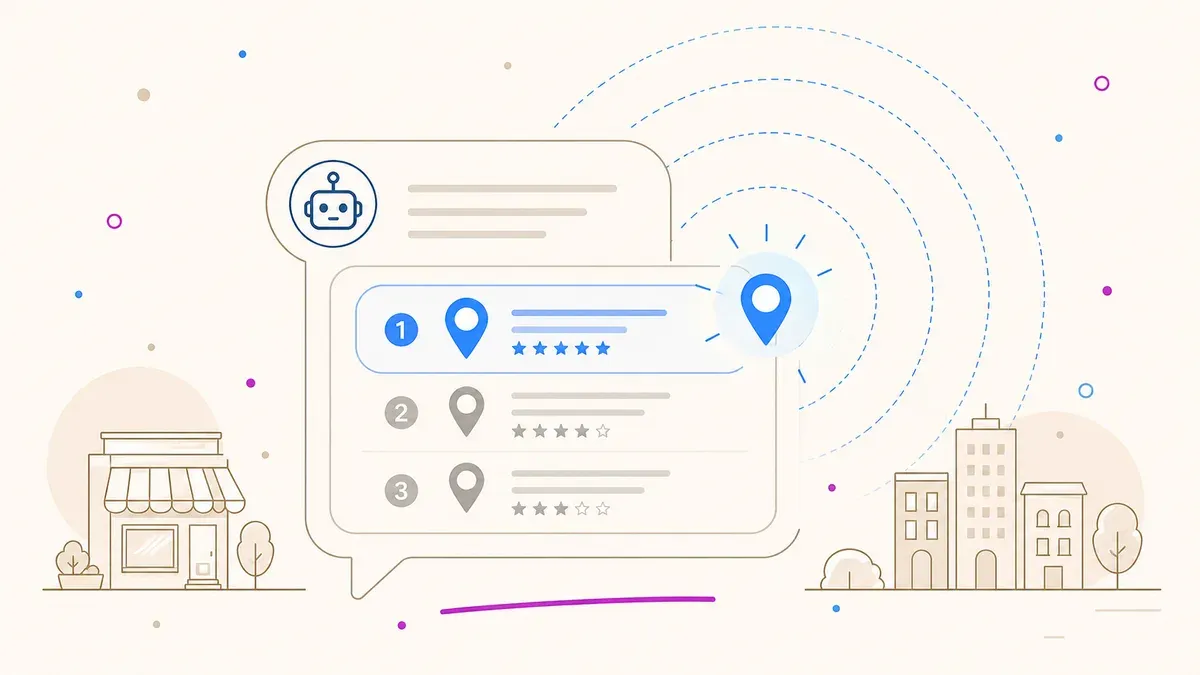
In a classic Google search, you see 10 organic results. Each is a link to a website. You click, you read, you decide. In an AI-powered search, something different happens: the system reads multiple sources, synthesizes an answer and displays it directly. Source links appear as small footnotes – if at all.
The numbers are clear. Current studies show zero-click rates in comparison:
64.82% of all Google searches already end without a click. With AI Overviews, that rises to 83%. In the new AI Mode – Google's fully AI-driven search – it's 93% zero-click. This doesn't only affect informational queries. Transactional and navigational searches are increasingly answered directly too.
For your business, this means: the remaining clicks are distributed across fewer sources. An AI answer typically cites 2 to 7 domains – instead of the 10 organic results on a classic search results page. If you're not among those 2 – 7, you get zero.
But there's a flip side: brands that appear in AI Overviews receive on average 35% more organic clicks and 91% more paid clicks. Visibility in an AI answer acts as a trust signal – also for the traditional results below it.
The numbers: why SMBs need to act now
The shift toward AI-generated answers is not a future scenario. It's happening now.
Google AI Overviews now appear on 48% of all search queries (as of March 2026). In February 2025, it was 31%. That's an increase of over 50% in 13 months. The trend is accelerating.
ChatGPT has 900 million weekly users and holds 68% market share among AI chatbots. Google's Gemini follows with 18.2%. Add Perplexity, Copilot, Claude and others. The user base that expects answers instead of links grows every month.
At the same time, fewer than 12% of marketing teams are prepared for this shift. That's the gap you can exploit.
If you've set up your tracking properly, you can already see the decline in organic traffic in your GA4 data. Impressions in Google Search Console stay stable or rise – but the click-through rate drops. That's the typical pattern when AI Overviews absorb clicks.
5 concrete GAIO measures for your website
GAIO sounds abstract but translates into concrete steps. You can implement the following five measures without a big budget and without a dev team.
1. FAQ sections as the highest-leverage move
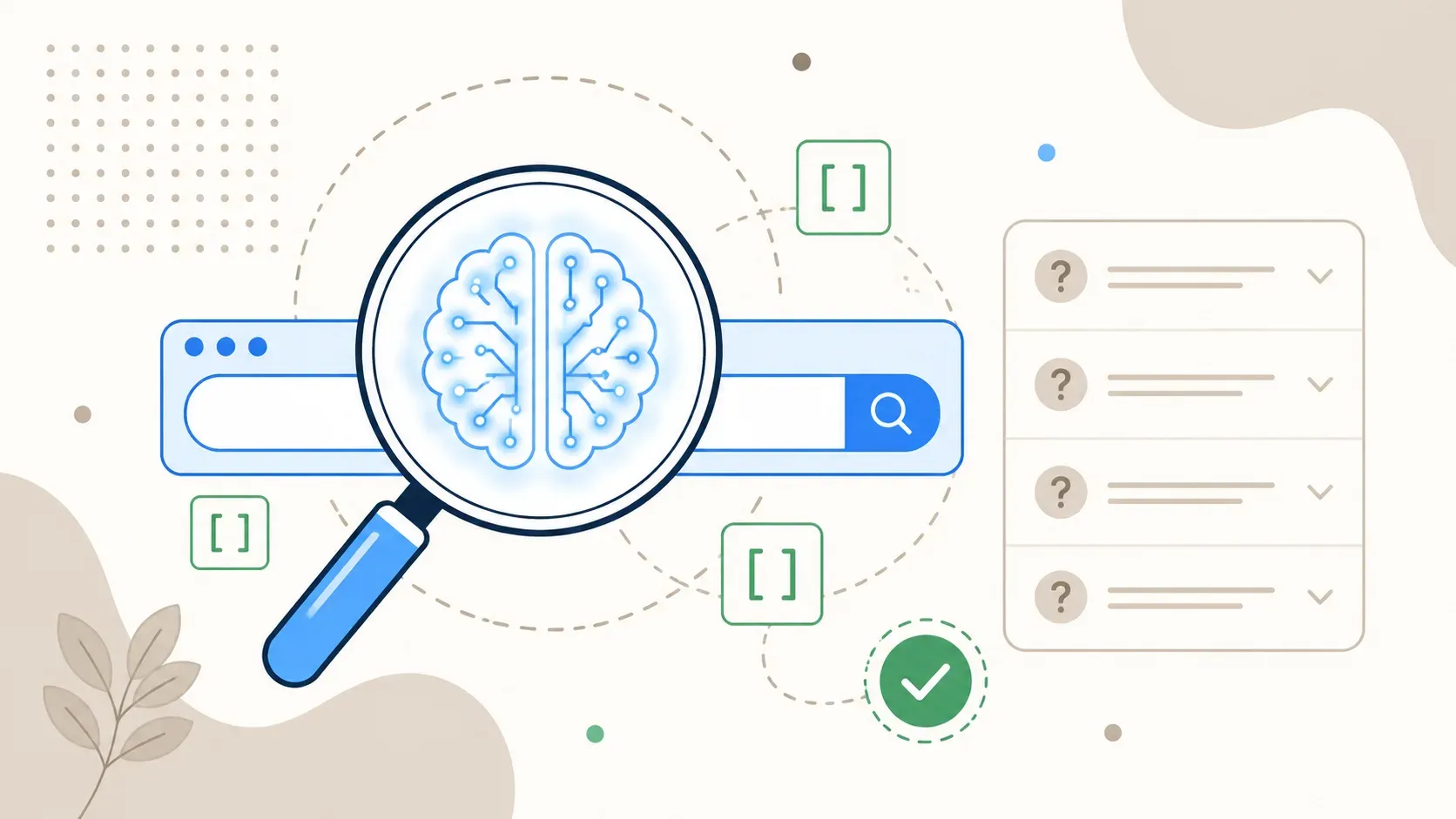
AI systems love question-answer pairs. They're the simplest format for getting cited as a source. The reason: LLMs look for content that answers a user question directly and concisely. A well-written FAQ hits exactly this pattern.
Add 4 – 6 FAQ entries to every important page. Write the questions in natural language – the way a user would type them into ChatGPT or Google. Answer each question in 2 – 4 sentences, directly and without filler. Use FAQ schema markup (JSON-LD) so the structure is also machine-readable.
A local trades business that supplements its local SEO strategy with FAQ sections covers both channels at once: Google and AI search.
2. The first 200 words decide
LLMs weight the beginning of a document more heavily than the rest. The logic: if the core statement is in the first paragraphs, the source is likely relevant and authoritative. If the answer only appears in paragraph 12, the source often gets skipped.
Write your articles in inverted-pyramid style: the most important information first, then context, then details. Every blog post, every service page, every landing page should answer the central question it's meant to rank for within the first 200 words.
3. llms.txt – the new robots.txt
Just as robots.txt tells search engine crawlers which pages they can index, there's now an equivalent for AI systems: llms.txt. This file sits in your website's root directory and tells AI crawlers what your site is, what it offers and which content is most relevant.
The format is simple – a Markdown file with structured information:
# Company Name
> Brief description of the business in 1 – 2 sentences.

## Services
- [Service 1](https://example.com/service-1): Brief description
- [Service 2](https://example.com/service-2): Brief description

## Blog
- [Article Title](https://example.com/blog/article): Brief description
Create this file, upload it as llms.txt to your root directory and optionally link it in your site's <head>. It takes 30 minutes and clearly signals to AI systems what you're the authority on.
4. Content freshness: the 14-day cycle
AI systems with live retrieval prefer fresh content. Studies show that content without freshness signals loses citation priority after about 14 days. That doesn't mean you need to write new articles every two weeks. It means you should regularly update existing content.
In practice: update your most important pages every 2 – 4 weeks. Add new data, update statistics, add a current paragraph. Change the dateModified field in your schema markup. The signal to AI systems: this source is maintained and current.
If you work with AI tools like Claude, you can partially automate this update process – for example by automatically checking which pages haven't been updated in more than 14 days.
5. Structured data and entity clarity
LLMs understand structured data better than running text. Schema.org markup – especially for Organization, FAQPage, Article and HowTo – gives AI systems machine-readable information about your business and your content.
Beyond that, entity clarity helps: make sure your business name, core topics and authority are communicated consistently across all pages. AI systems build a picture of who is a trustworthy source for which topic. Inconsistent information dilutes that picture.
Measuring success: the 3 KPIs of AI visibility
Classic SEO KPIs – rankings, organic traffic, click-through rate – are no longer enough to measure your total search visibility. For GAIO, you need three new metrics:
1. Mention rate: How often is your brand or domain mentioned in AI-generated answers? Tools like Semrush, Ahrefs and specialized GAIO trackers offer early monitoring features for this. You can also test manually: ask your key target questions in ChatGPT, Perplexity and Google AI Mode and document whether you appear as a source.
2. Citation rate: How often are you not just mentioned but cited with a link? A mention without a link builds brand awareness. A citation with a link drives traffic. The citation rate is the more direct indicator of GAIO ROI.
3. Position in the AI answer: When you're cited – where? The first source mentioned gets more attention and more clicks than the third or fifth. Similar to position 1 vs. position 5 on Google: the higher up, the better.
Set up monthly monitoring. Track 10 – 20 of your most important keywords in AI systems and document mention rate, citation rate and position. After 3 months, you'll have a baseline to measure progress against.
GAIO is not an SEO replacement – it's the extension
GAIO doesn't replace good SEO. Technical SEO, on-page optimization, backlinks, local SEO – all of that stays relevant. Google isn't getting rid of organic results. The 10 blue links will still exist in 2027.
But the share of traffic coming through those 10 links is shrinking. AI search absorbs clicks. Users who get answers from ChatGPT, Perplexity or Google AI Mode visit fewer websites. And that share grows month by month.
If you set up a GAIO strategy now, you secure visibility in a channel that most competitors are still ignoring. The measures – FAQ sections, inverted pyramid, llms.txt, content freshness, structured data – are neither expensive nor complicated. They require discipline and consistency.
And they pay off twice: everything that makes your content better for AI systems also makes it better for classic SEO. Clearer structure, better answers, fresher data – Google rewards that just as much as ChatGPT does.
GAIO strategy for your SMB?
We analyze your current AI visibility and implement the measures that position you as a cited source.
Free consultation →