Leaving Wix: What Now? Alternatives for 2026
Wix stock down 79%, 20% layoffs, AI site builders rising. Why the rental model is your real risk, and how to get out with headless WordPress or Next.js + Payload.
A video claims Wix is on its way out, and the chart seems to back it up: down 79 percent from its peak, a slide from USD 191 to roughly USD 40 at the low (stockanalysis.com, August 2026). The number checks out. The headline is misleading anyway. Wix is still growing, turns an operating profit, and has more registered users than ever.
The concern is valid, just for a different reason. When your website runs on Wix, your risk is not the share price but the dependency behind it. This post sorts out what is actually true about the Wix crisis, what happens when a rented platform pulls the plug, and which paths out of the site builder exist in 2026: headless WordPress and Next.js with Payload CMS.
- "Wix is finished" is not accurate: revenue up 15 percent year over year, roughly USD 600 million in free cash flow per year, 304 million registered users (end of 2025).
- But: the stock fell 79 percent from its high, Wix laid off around 20 percent of its workforce in May 2026, and bought the AI site builder Base44 for about USD 80 million. AI website generators are putting the site builder model under pressure.
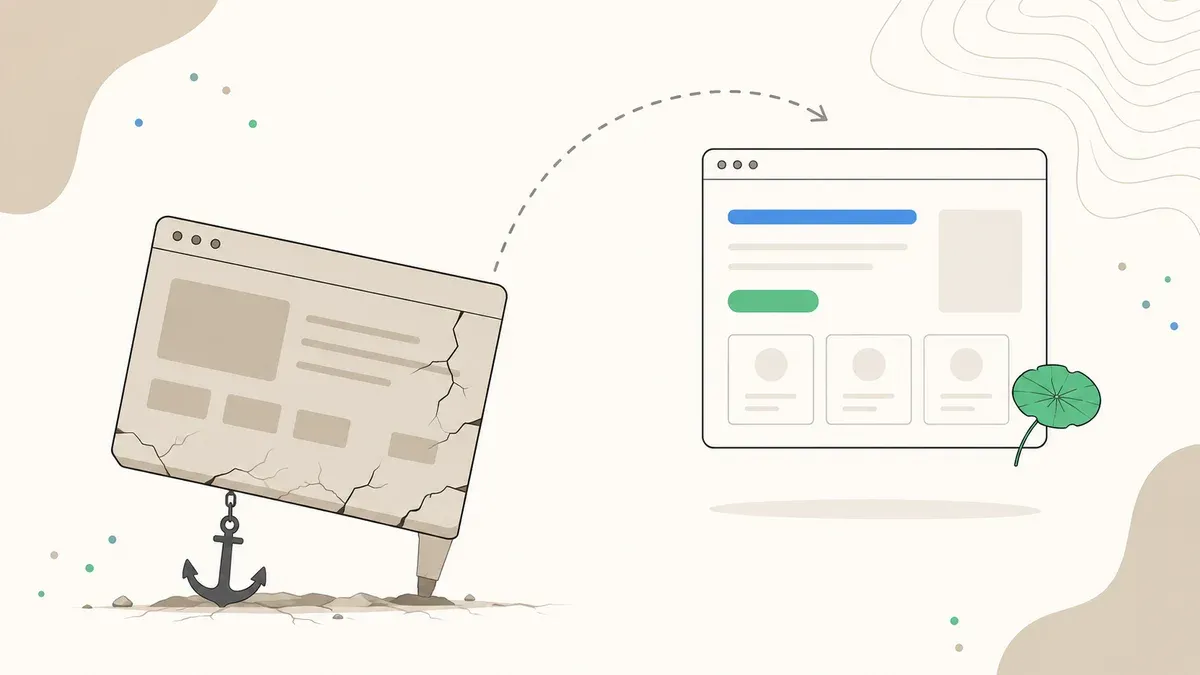
- Your real problem is not the stock but the rental model: on Wix you cannot export your site, a move means a rebuild, and the provider dictates price, features, and whether it keeps running.
- The alternative is a platform you own: headless WordPress or Next.js with Payload CMS, self-hosted in the EU. Ownership instead of rent, full performance, data sovereignty.
What is real about the Wix crisis – and what is not
The stock slide is real and had a concrete trigger. On May 13, 2026, the stock lost roughly 27 percent in a single day after Wix reported its quarterly figures: revenue did rise 14 percent, but adjusted earnings per share missed expectations by a wide margin (The Motley Fool, June 2026). Two weeks later, Wix announced it would cut around 1,000 positions, about 20 percent of its workforce (Quartz, May 2026).
So much for the headline. The other half of the story is missing from the video. Wix keeps growing: in the second quarter of 2026, revenue came in at USD 563 million, up 15 percent, with free cash flow above USD 50 million for the quarter (StockTitan, August 2026). According to its annual report, the company counts 304 million registered users, a good eight percent more than a year earlier (Wix Form 20-F, SEC). A company with these numbers is not going under tomorrow.
So the fair read is this: Wix is not facing bankruptcy but pressure to reinvent itself. The stock market is not pricing in a collapse but the fear that a new technology is attacking the core business. And that fear has a name.
Why Wix is wobbling: the AI site builders
Since 2025, tools have emerged that build a website or app through chat: you describe what you want, the AI generates the code. Lovable reported going from zero to USD 200 million in recurring revenue within twelve months by its own account, Bolt.new USD 20 million in two months (company figures, aggregated by industry media). For a classic site builder whose promise is "a website without code," that is a direct hit on exactly that promise.
Wix responded by buying its own attacker. In June 2025, Wix acquired the roughly six-month-old startup Base44 for about USD 80 million in cash (Wix Press Room, June 2025). That is the most telling signal in this whole story: even Wix considers the classic site builder vulnerable enough to pay USD 80 million for the technology that could replace it.
For you as a website owner, that means the platform your site sits on is remaking itself right now. New pricing models, new priorities, dropped features – all of that is more likely during a reinvention phase, not less. And this is exactly where the problem begins, the one that has nothing to do with the share price.
The real problem is not the share price but the dependency
A Wix website is something you rent. You pay monthly for the right to keep it online, and the moment you stop paying, it goes offline. That alone would be manageable if you could take it with you. But you cannot: Wix offers no complete export. There is no button that hands you your design, your layout, and your page structure as files you can set up again somewhere else. The only things you can take are the domain, your raw text, and images (NoCodeExport, 2026). Everything else stays with Wix.
A move away from Wix is therefore not an export but a rebuild. And a rebuild without a plan also costs you your Google rankings, because all the URLs change and the old ones lead nowhere. That is the flip side of convenience: the site builder takes the technology off your hands by keeping it from you.
On top of that comes the price, which Wix alone decides. In 2024, Wix raised the monthly price of a premium plan in Europe from EUR 9.84 to EUR 17.22, a hike of roughly 75 percent (TechRadar). In 2025, the old plans were scrapped entirely and replaced with new ones. Anyone who rents accepts jumps like these or moves – and moving, as just described, means a rebuild.
What that same switch feels like with ownership at the end is shown in our field report on a yoga studio that left its site builder: from 22.5 megabytes down to 0.33 megabytes, with a site the studio then owned itself.
What happens when the platform stops delivering
"Wix is too big to disappear" sounds reassuring but is disproven by history. The world's most financially powerful corporations have shut down web services and deleted user data in the process:
- Yahoo GeoCities was shut down in 2009. Around 38 million user websites vanished from the servers, and a large part of early web history was lost (TIME, 2009).
- Adobe Muse, a website site builder, was discontinued in 2020, and its accompanying hosting Adobe Business Catalyst was shut down entirely in 2021 – after which the data was deleted (CMS Critic).
- Google+ went offline in 2019, and content was deleted. In 2023, Google sold its domain business to Squarespace, and roughly ten million domains changed providers overnight.
And Wix itself has already shown how quickly a site can disappear. In September 2024, Wix announced that, due to US sanctions, it would suspend all Russian accounts and take the associated websites offline, including the paid ones. Three days lay between the announcement and the shutdown. The only recommended way to save your site: transfer the domain to another provider in time (BleepingComputer, September 2024). That is not a rumor but a documented case in which an entire region was switched off with the stroke of a pen.
The structural risk in three points
- No export: design, code, and structure belong to the platform. All you hold in your hand is the domain and raw text.
- Rent instead of ownership: the provider dictates price, features, and continued existence, see the 75 percent price increase in 2024.
- A single point of failure: hosting, software, account, and visibility all hang on one provider. If one falls away, everything falls.
With a platform you own, the same scenario is a shrug. When the design company Figma acquired the CMS Payload in June 2025, the software stayed open source under an irrevocable MIT license and remained self-hostable (Figma Blog, June 2025). Anyone self-hosting Payload noticed nothing of the acquisition. The code keeps running, no matter who owns the company behind it. That is exactly the difference between renting and owning.
What now: three ways out of the site builder
Most "Wix alternative" lists only swap one rented site builder for the next: Squarespace, Jimdo, Webflow. That does not solve the underlying problem. Anyone who really wants to end the dependency switches to a platform with an open foundation. Three paths have proven themselves for small and medium-sized businesses.
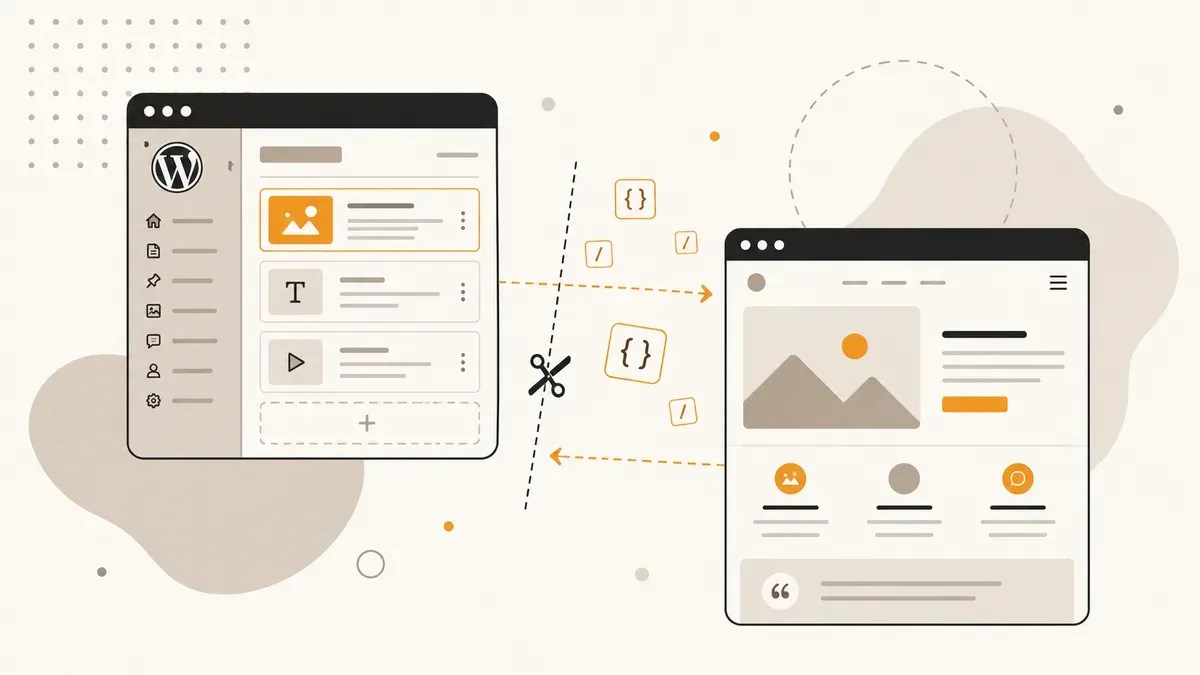
Headless WordPress. Here WordPress runs only as an editorial system in the background, the frontend is decoupled from it and connected through an interface (REST or GraphQL), rendered with a fast modern framework. The advantage: the familiar WordPress interface for editing, but without the slow, attackable classic setup. When this separation is worth it we cover in detail in Headless WordPress: when the separation is worth it.
Next.js with Payload CMS. Payload is an open source CMS built on TypeScript that you host yourself and that, since version 3, runs directly inside a Next.js application, in the same project (payloadcms.com). There is no monthly CMS fee, the data sits on your server, the server location is freely selectable, so GDPR-compliant in the EU as well. This is the path we recommend for projects with custom features, and exactly the stack the yoga studio linked above was built with.
Astro. For content-heavy sites like corporate websites and blogs, Astro is ideal: extremely fast, because by default it ships almost no JavaScript. This website itself runs on Astro. Which technology fits which project we compare in depth in WordPress or Next.js for SMBs.
| Criterion | Wix (site builder) | Headless WordPress | Next.js + Payload |
|---|---|---|---|
| Ownership | rent, no export | yours | yours |
| Server location | global, mostly USA | freely selectable (EU) | freely selectable (EU) |
| Customization | limited to the site builder | high | unlimited (your own code) |
| Edit content yourself | yes | yes (WordPress interface) | yes (Payload interface) |
| Ongoing costs | subscription, permanent | hosting | hosting |
| On provider acquisition | strategy can shift | open source keeps running | open source keeps running |
Is Wix slow? A fair aside
A common accusation is that Wix is inherently slow. That is no longer accurate. On the platform average, more Wix sites even pass the Core Web Vitals than WordPress sites, 52 versus 38 percent on mobile (Search Engine Journal, data from HTTP Archive). The reason: Wix optimizes the infrastructure automatically, while many WordPress sites run on cheap hosting with overloaded plugins.
So the real drawback is not the raw load time but the lack of control. On Wix you cannot get at the code, the server, or the delivery. A cleanly built custom development beats both averages by a wide margin: the linked yoga studio project reaches 99 out of 100 points in PageSpeed Insights. The difference does not come from a trick but from having the architecture in your own hands.
What does it cost – renting vs. owning
A site builder seems cheaper because the costs come in small monthly installments. Wix Business runs at roughly USD 39 a month, over five years that is roughly EUR 2,300 in pure rent, after which you own nothing. A custom development costs more upfront, after which only the hosting costs remain, and the result is your property. A comparison calculation for the DACH region puts the three-year cost of a Wix site at EUR 1,000 to 5,700, and that of a WordPress solution at EUR 1,900 to 5,400 (Werbeagentur Landau) – comparable ranges, but one with permanent rent, the other with ownership and portability.
The fair answer is therefore not "custom is always cheaper." It is: for a similar budget you get ownership, performance, and data sovereignty instead of a subscription that never ends. How the line items break down in detail we lay out in What a website costs in 2026.
How the move works
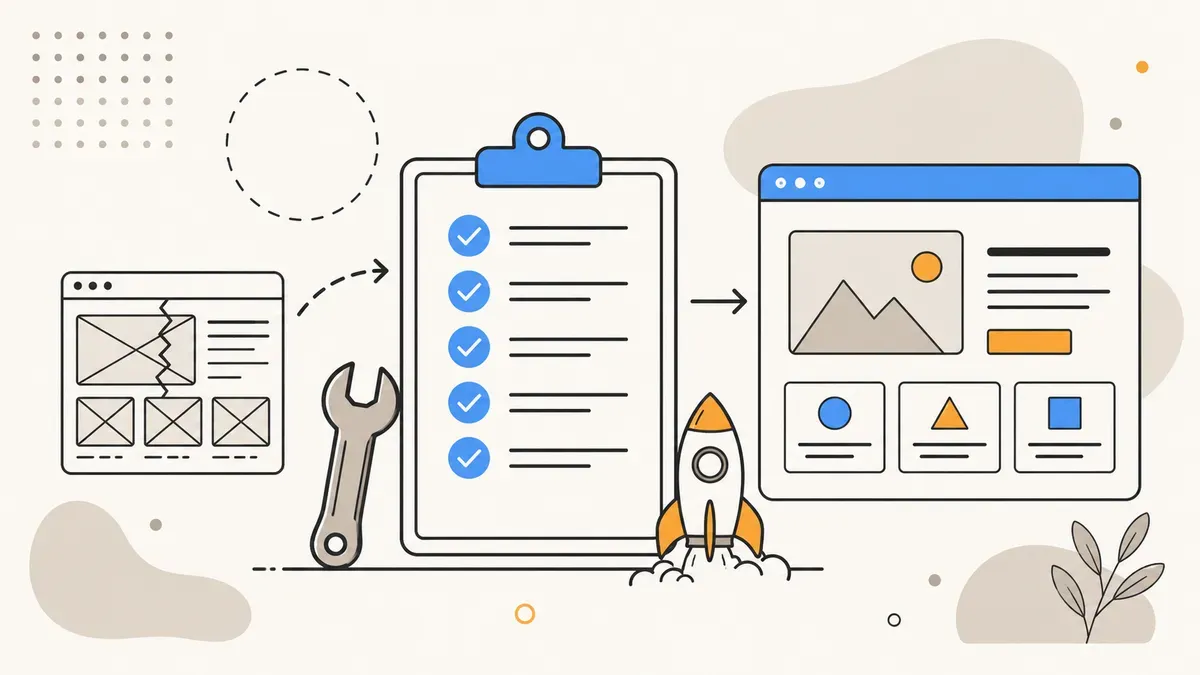
A switch from Wix can be planned if the order is right. Anyone who cancels first risks the domain, rankings, and email delivery. The clean way:
- Secure what exists: capture all existing URLs and archive the content before anything is switched off.
- Rebuild in parallel: finish the new site under a temporary address while the old one stays online.
- Save the rankings: set up a 301 redirect from every old Wix URL to the new address so Google positions and backlinks are preserved.
- Move the domain: only once the new site is in place, switch the domain and reset the email records. Note: Wix allows a domain transfer only 60 days after purchase.
How a relaunch without ranking loss works in detail is in our relaunch checklist 2026. Anyone who wants to make sure nothing is left undone on data protection will find the basics in GDPR-compliant hosting.
What you get after the switch
Six things you were missing before
- Ownership instead of rent: the website is yours, with code, database, and design. No subscription running into eternity.
- Real performance: a modern frontend instead of site builder ballast, with Core Web Vitals scores that translate into rankings and fewer bounces.
- Data sovereignty: self-hosted with a freely selectable EU server location, clean for GDPR.
- Unlimited features: anything is possible because you own real code. No "sorry, the site builder doesn't allow that."
- No platform dependency: an open foundation that survives acquisitions and pricing rounds, see Payload and Figma.
- AI readiness: a clean structure, structured data, and an llms.txt so that search engines and AI systems can find and understand you in 2026.
All of these paths are part of our web development. Whether headless WordPress, Next.js with Payload, or Astro is the right choice depends on your project, not on a platform that happens to be running ads right now.
Frequently asked questions
Is Wix really going bankrupt?
It does not look that way. The share price has indeed fallen around 79 percent from its high and Wix laid off roughly 20 percent of its workforce in 2026, but revenue is growing at double digits and the company generates high free cash flow. The risk to you is not insolvency but the dependency on the rental model.
Can I move my Wix website to WordPress?
Yes, but there is no clean export. Wix hands over only the domain, text, and images, so design and structure have to be rebuilt. With 301 redirects from every old URL, the Google rankings are preserved.
What is Payload CMS and is it free?
Payload is an open source CMS built on TypeScript that you host yourself. The software is free under the MIT license, there is no monthly CMS fee, only the hosting costs. Since version 3, Payload runs directly inside a Next.js application.
Will I lose my Google ranking when moving from Wix?
Only if you move without a plan. If every old Wix URL points to its new address via a 301 redirect and the content is preserved, the rankings move along with it. Crawling the old site before switching it off is the insurance for that.
Is a self-hosted website more GDPR-compliant than Wix?
It gives you more control. With a self-hosted solution you choose the server location freely and can host in an EU data center. Wix processes data globally, mostly on US infrastructure, which keeps third-country transfer a permanent issue.
Is your website stuck in a site builder?
We secure what you have, set up the 301 redirects, and build you a site that is yours – with numbers instead of gut feeling.
Request a no-obligation quote